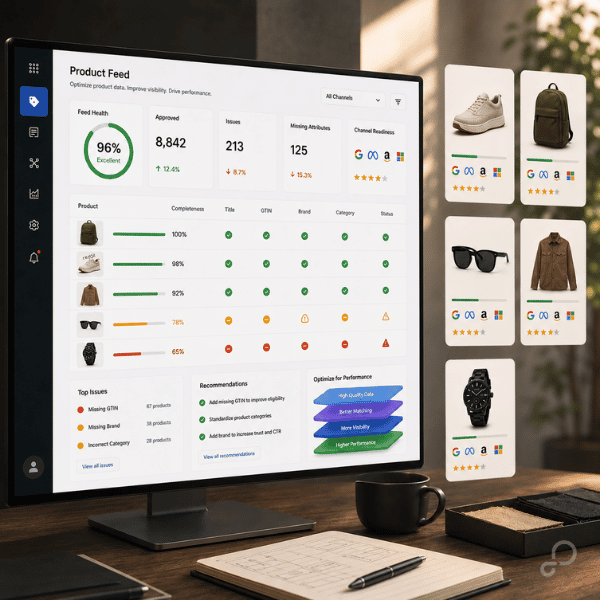




















































Some sellers are still treating their product feed as an IT compliance checklist. It’s the single biggest gap we see between our high-performers and their competitors. This is a structural error. Modern retrieval algorithms use your feed as the primary semantic input dictating Smart Bidding logic and auction eligibility.
Shopping campaigns can only optimize using the product feed strategy they're given. When that data is incomplete, inconsistent, or outdated, performance starts to erode long before Merchant Center surfaces a single account issue.
That's why accurate product data isn't just about getting products approved. It influences how Google classifies your inventory, matches search intent, segments products, and ultimately decides where your ads compete.
Your product feed is the source code for the transaction. If Google's systems can't confidently identify what you're selling, they're more likely to match your products to the wrong searches, limit visibility in relevant auctions, or make less informed bidding decisions. Those issues don't always show up as errors, but they often show up in your campaign performance.
Google Shopping, Performance Max, Microsoft Advertising, and Meta Commerce Manager don't optimize your ecommerce catalog. They optimize the structured product data you send them.
Merchant Center approvals often create a false sense of confidence. A product can be fully approved while still lacking the signals Google's systems use to match it with the right searches.
Think about these two product titles:
Running ShoesMen's Brooks Ghost 16 Running Shoes Blue Size 10Both products may pass Google's requirements. Only one gives Google's systems enough context to confidently match it with highly relevant searches because of its optimized product titles.
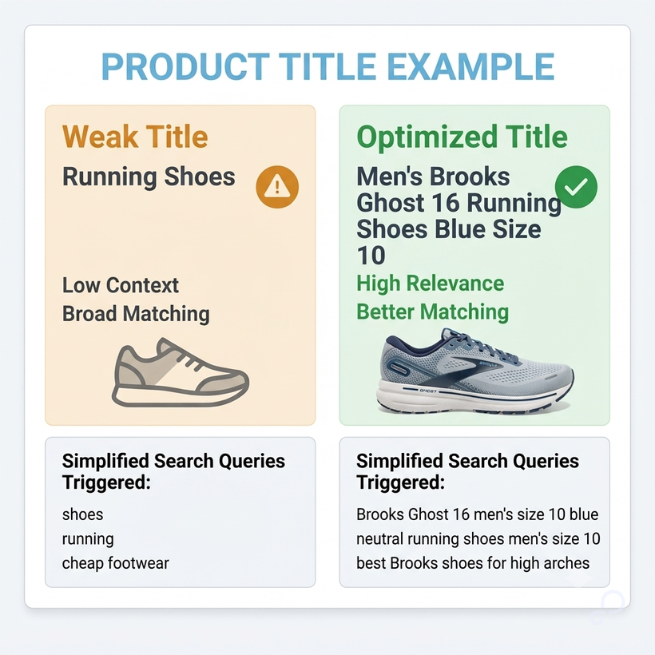
Merchant Center isn't grading your feed for performance. It's grading it for eligibility.
That's the distinction many teams miss. Eligibility gets your products into the auction. Data quality determines whether they compete in the right auctions.
I've seen catalogs with virtually no Merchant Center errors still struggle because Google's matching products to broad, low-intent searches. The campaigns weren't broken. The feed simply wasn't giving Google's systems enough confidence to match products precisely.
That might sound like a small difference, but it's where Shopping performance often starts drifting long before anyone notices it in campaign reports.
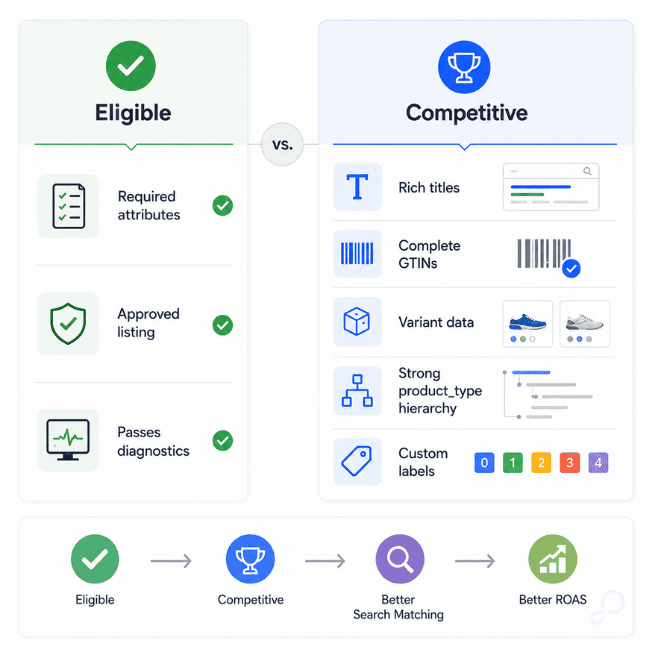
Most feeds break at the same point. They're technically complete, with the required fields, passing diagnostics, and publishing without issue. Yet click-through rate slowly declines, search queries become less relevant, and Smart Bidding has fewer strong signals to work with.
Nothing in the feed is technically wrong. The data just isn't specific enough for Google to tell similar products apart.
One example I've seen more than once involves apparel catalogs where every color variant shares nearly identical product titles. The only difference is the SKU hidden in the feed. Merchant Center approves everything, but Google has fewer signals to distinguish one variant from another.
Instead of a disapproval, you get weaker query matching, lower CTR, and less qualified traffic entering the campaign.
The same thing happens when product titles are written for internal merchandising instead of customer search behavior, GTINs are missing or inconsistent, or similar products use completely different category structures.
None of those issues trigger major warnings. They simply make your products less competitive.
Campaign restructuring cannot solve feed-layer attribute deficiencies.
Your feed is the semantic layer Google's systems read your inventory through. When attribute coverage is sparse, matching precision degrades and products get evaluated against broader, lower-intent queries.
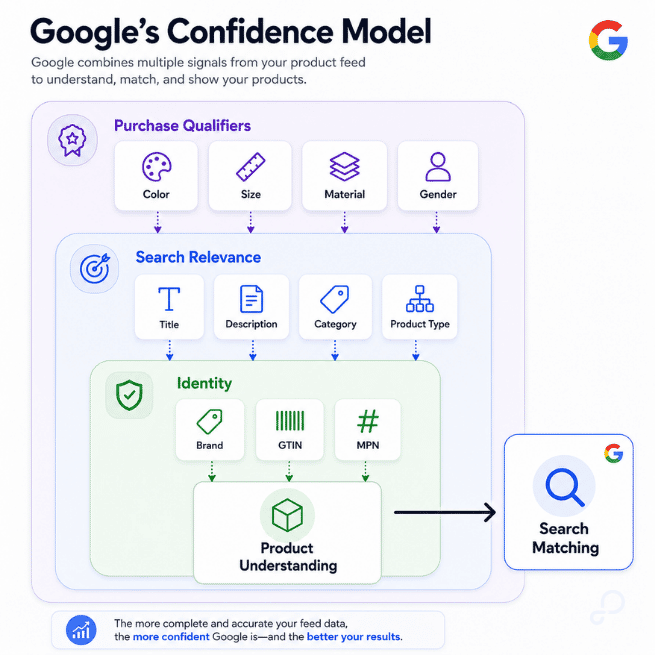
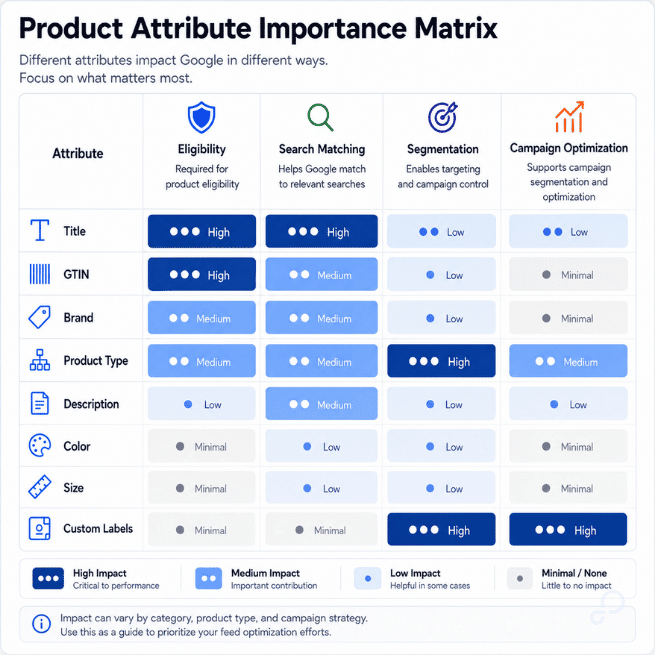
The most influential attributes generally fall into three groups:
Identity
brandgtinmpnSearch relevance
titledescriptiongoogle_product_categoryproduct_typePurchase qualifiers
colorsizematerialgenderconditionGoogle builds confidence from overlapping product attributes rather than relying on any single attribute.. The more those signals reinforce one another, the easier it becomes to match your inventory with highly specific searches.
Don't let this part trip you up. More attributes don't automatically create better performance. Accurate, consistent attributes do.
google_product_category and product_type also serve different purposes. google_product_category helps classify products within Google's taxonomy, while product_type is especially useful for organizing inventory, reporting, and campaign segmentation based on your own merchandising strategy.
For example, if valid GTINs and manufacturer brands already exist, preserve them. If they're missing, flag those products for enrichment before publishing the feed. Replacing standardized identifiers with custom values usually creates more problems than it solves.
This is where feed logic becomes campaign segmentation logic. Better product data improves the signals Google uses for product matching and auction eligibility before Smart Bidding evaluates each auction.
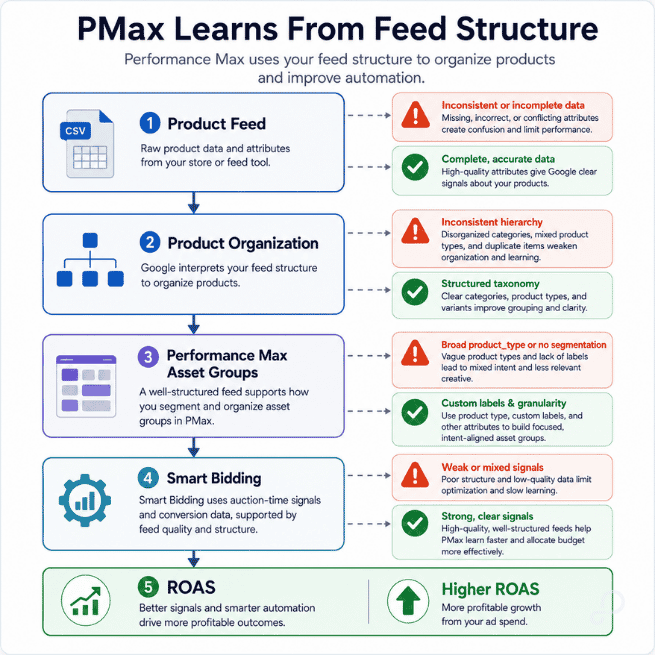
For retail, Performance Max derives its entire Listing Group routing and asset generation from your product feed. If product organization is inconsistent, campaign automation inherits those problems.
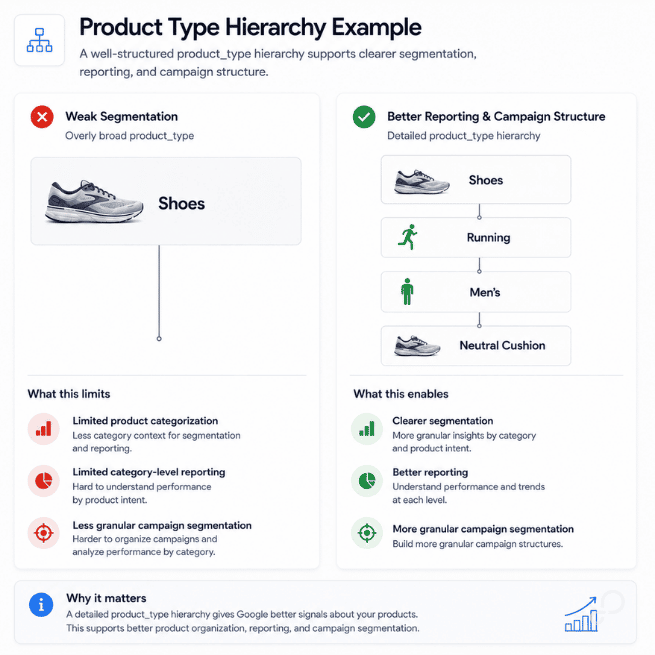
One issue that often flies under the radar is an overly broad product_type hierarchy. A category like Shoes doesn't provide much context. Something like Shoes > Running > Men's > Neutral Cushion creates a much stronger product_type hierarchy for reporting, optimization, and inventory management.
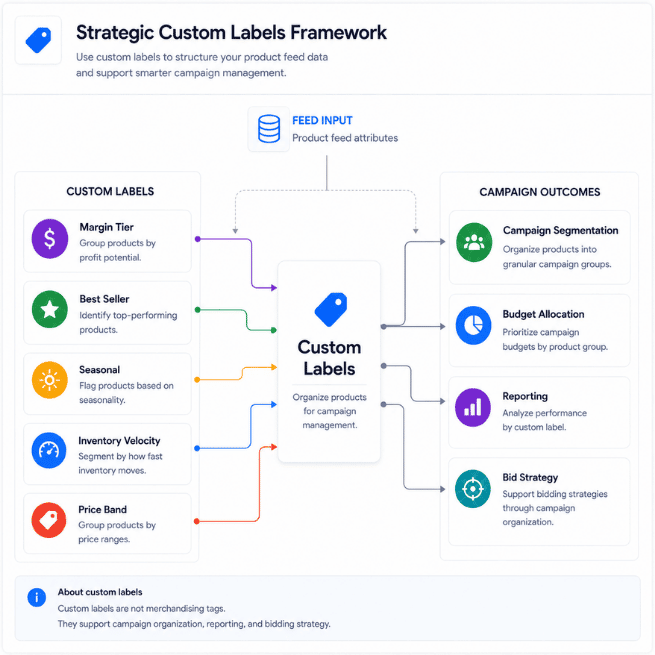
The same principle applies to custom labels. Many advertisers stop after creating a simple Sale label. That works for merchandising, but it doesn't do much for campaign strategy.
What you actually want are labels that reflect how you manage performance:
These labels don't directly influence auction ranking, but they make it much easier to segment inventory, build campaign structures, analyze performance, and apply different bidding strategies where appropriate.
Here's where many teams misdiagnose the problem. Performance Max starts producing inconsistent ROAS, so they assume Smart Bidding needs more time, or that the campaign structure needs another rebuild.
In reality, the campaign is learning from inventory that's been grouped too broadly, making it harder for automation to distinguish products that deserve different bidding strategies.
GoDataFeed makes this much easier by applying feed rules that automatically classify products across destinations, so campaign segmentation stays consistent as your catalog changes.
A shopper searches Black Nike Air Max Size 10. Your feed contains Nike Air Max. Google categorizes the item as a shoe, but without variant-level attributes it can't match that listing to a highly specific, long-tail query.
That's usually the result of incomplete variant data rather than campaign settings.
A consistent item_group_id tells Google that different sizes and colors belong to the same parent product, while attributes like color and size help identify the exact variant a shopper is looking for.
The most common causes include:
color attributessize valuesitem_group_id relationshipsVariant fragmentation breaks the retrieval system's ability to map long-tail queries to specific SKUs.
Lower relevance often leads to lower click-through rate, weaker landing page matches, lower conversion rates, and noisier campaign data. Every one of those problems makes optimization harder because the campaign is learning from weaker signals.
This is one of those issues that's much easier to prevent with good feed governance than troubleshoot after campaigns have already accumulated performance history.
Inventory synchronization often gets treated as an operations task. It's really a campaign efficiency problem.
The workflow looks simple:
Inventory update → Feed refresh → Google Merchant Center → Campaign eligibility → Auction participation
Every extra hour in that chain increases the chance you're advertising inventory that can't convert.
Out-of-stock products continue serving until updates propagate. Promotional prices lag behind website changes and trigger price mismatch disapprovals. Shoppers click ads for products that are no longer available.
Google's automatic item updates catch some of this by correcting price and availability from your landing page and structured data. Treat that as a safety net, not a sync strategy. It doesn't fix promotional timing, it doesn't reflect inventory velocity, and it means Google is inferring your catalog state instead of reading it from your feed.
Individually, those delays seem small. Across thousands of SKUs, they become wasted budget and unnecessary friction.
Automated feed refreshes help reduce those gaps by keeping inventory and pricing synchronized across channels before outdated data starts affecting campaign performance.
The difference between reactive teams and mature operations comes down to where they spend their time. Reactive teams fix products; experienced teams fix processes.
Instead of manually editing hundreds of SKUs, they build feed rules that solve recurring problems once.
Not every optimization belongs in your ecommerce platform. Feed rules are often the better place to standardize channel-specific attributes without changing your source catalog, allowing you to tailor data for Google, Microsoft, Meta, or marketplaces while keeping your core product data intact.
Say you're pulling inventory from five suppliers that each use their own category structures. Rather than cleaning those categories every time new products arrive, create a rule that maps supplier values into your own standardized taxonomy before the feed reaches Google using rule operators.
The same approach works for:
gender or age_group valuesGoDataFeed's rule engine provides programmatic catalog governance, enforcing structural consistency before your data reaches Merchant Center and every other channel endpoint.
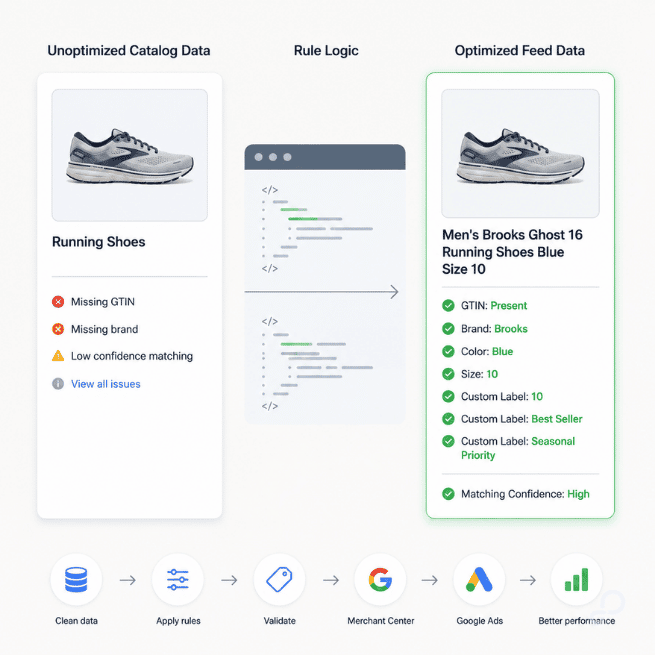
Don't review your feed the same way Merchant Center does. Merchant Center checks whether products are eligible. You should be checking whether they're competitive.
That means regularly reviewing:
product_type hierarchyMost performance marketers review campaigns every week but only inspect their feed after Merchant Center raises an error. By then, performance has often been slipping for weeks through weaker query matching, poorer segmentation, and lower-quality auction participation, the kind of issues that rarely generate a diagnostic warning.
The strongest Shopping campaigns rarely begin inside Google Ads. They begin upstream, where product data is standardized, enriched, and governed before it ever reaches Merchant Center. This is where poorly structured catalogs waste conversion signal and fragment campaign learning.
Treat your feed as part of your campaign strategy, not as an operational task that only deserves attention when something breaks. Strong product data gives Google's systems better signals for product matching, and it gives automation from Smart Bidding to Performance Max better inputs to work from.
If you're looking for one practical next step, review your current product issues in Merchant Center, then compare those findings against your product titles, identifiers, variant data, and custom labels. You'll often uncover performance opportunities that no bid adjustment or campaign restructure could have fixed.
Carlos Rodriguez is a seasoned content marketer with a background in marketing and advertising. Formerly at the helm of his own marketing agency, he now dedicates his expertise to guiding ecommerce merchants and marketers in mastering multichannel strategies. Outside of work, Carlos is an avid reader and hiker, often found traversing the mountain ranges of Cundinamarca like El Quinini.
Run a free feed audit and see which of your titles are matching queries you'd never choose to bid on.