



















































Home / Solutions / 3P Marketplaces
Solution — 3P Marketplace Feeds
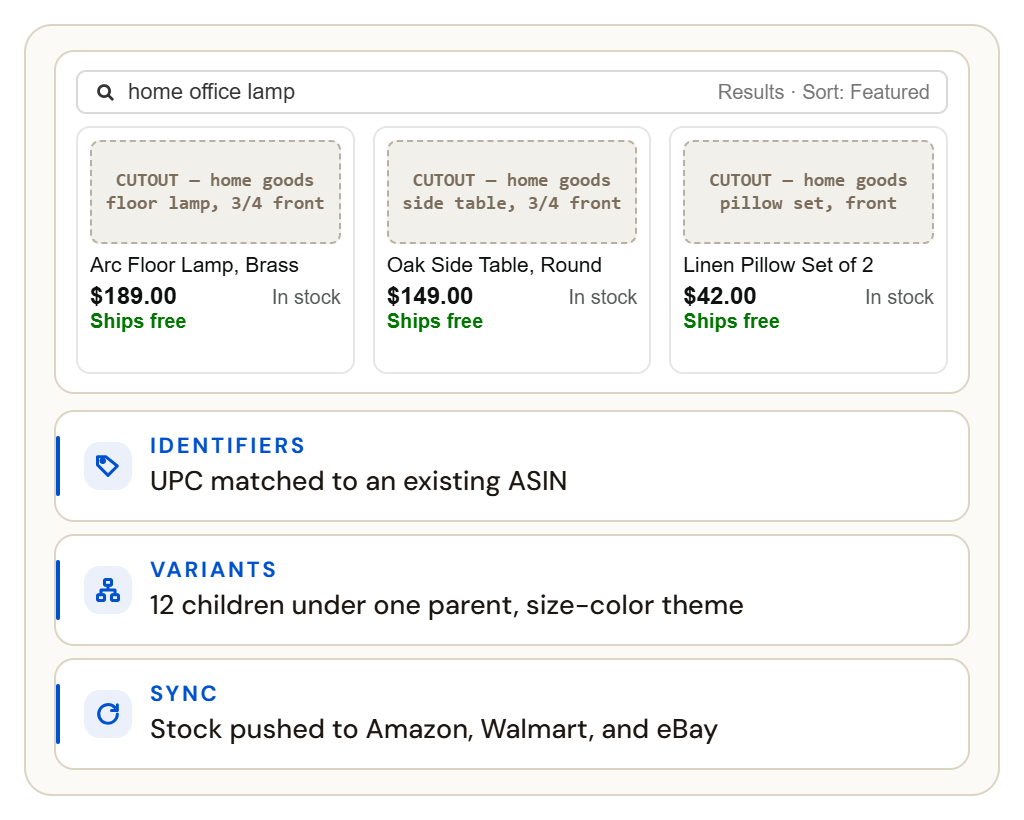
Amazon, Walmart, and eBay each score your catalog against their own rulebook and suppress what fails. GoDataFeed matches identifiers, rebuilds variant families, and maps your products to each marketplace's taxonomy before submission, then syncs stock out and orders back so listings stay accurate after they go live.
56%
of US online shoppers start product searches on Amazon (Jungle Scout, 2024)
61%
of paid units on Amazon come from third-party sellers (Amazon, Q1 2025)
200K+
active sellers on Walmart Marketplace, a record (Marketplace Pulse, 2025)
How the catalog becomes the listing
Match the identifiers
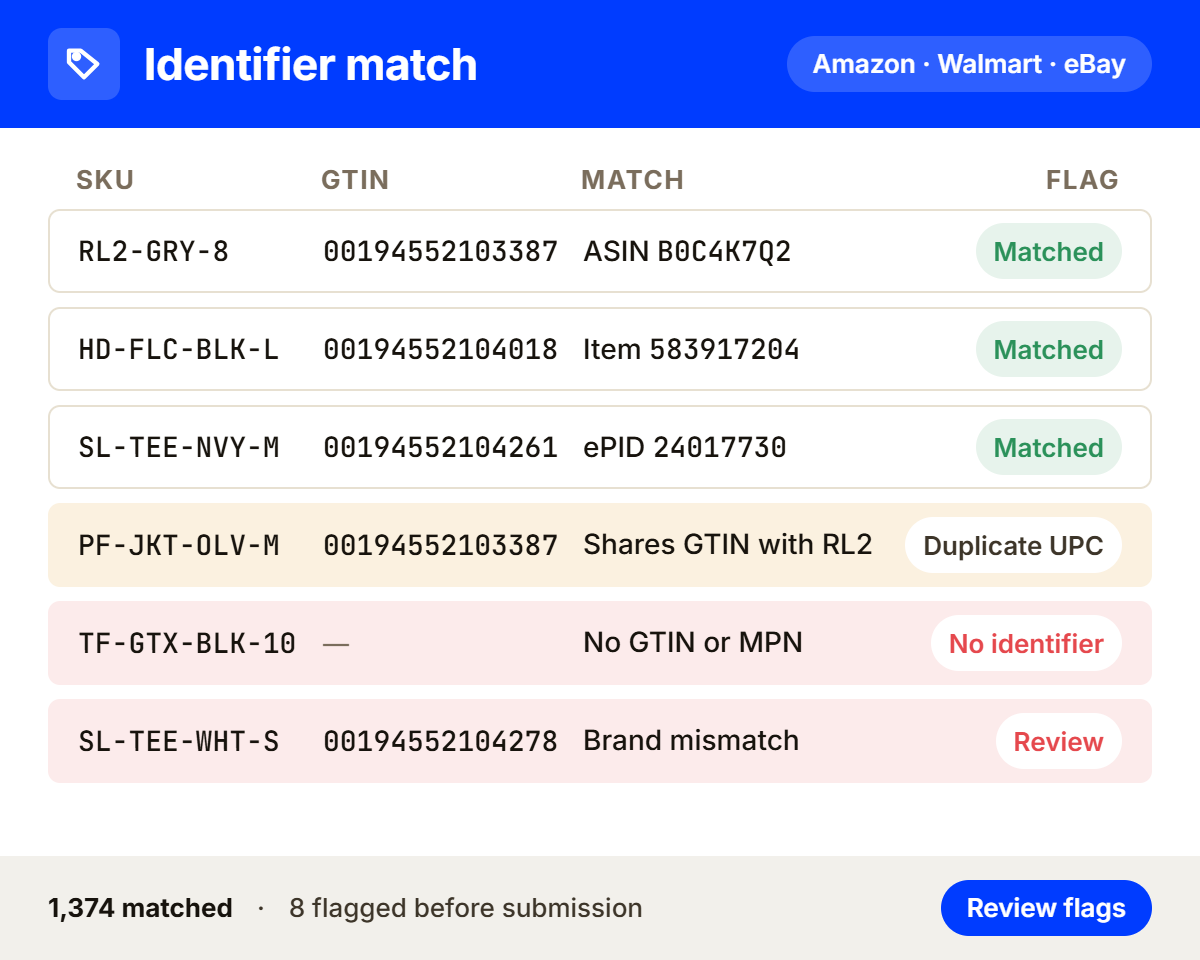
Marketplaces reject what they can't match. GoDataFeed checks GTINs, brands, and MPNs against each marketplace's identifier rules and flags collisions, such as duplicate UPCs, missing identifiers, and brand mismatches, before a listing enters the queue.
Rebuild the variants
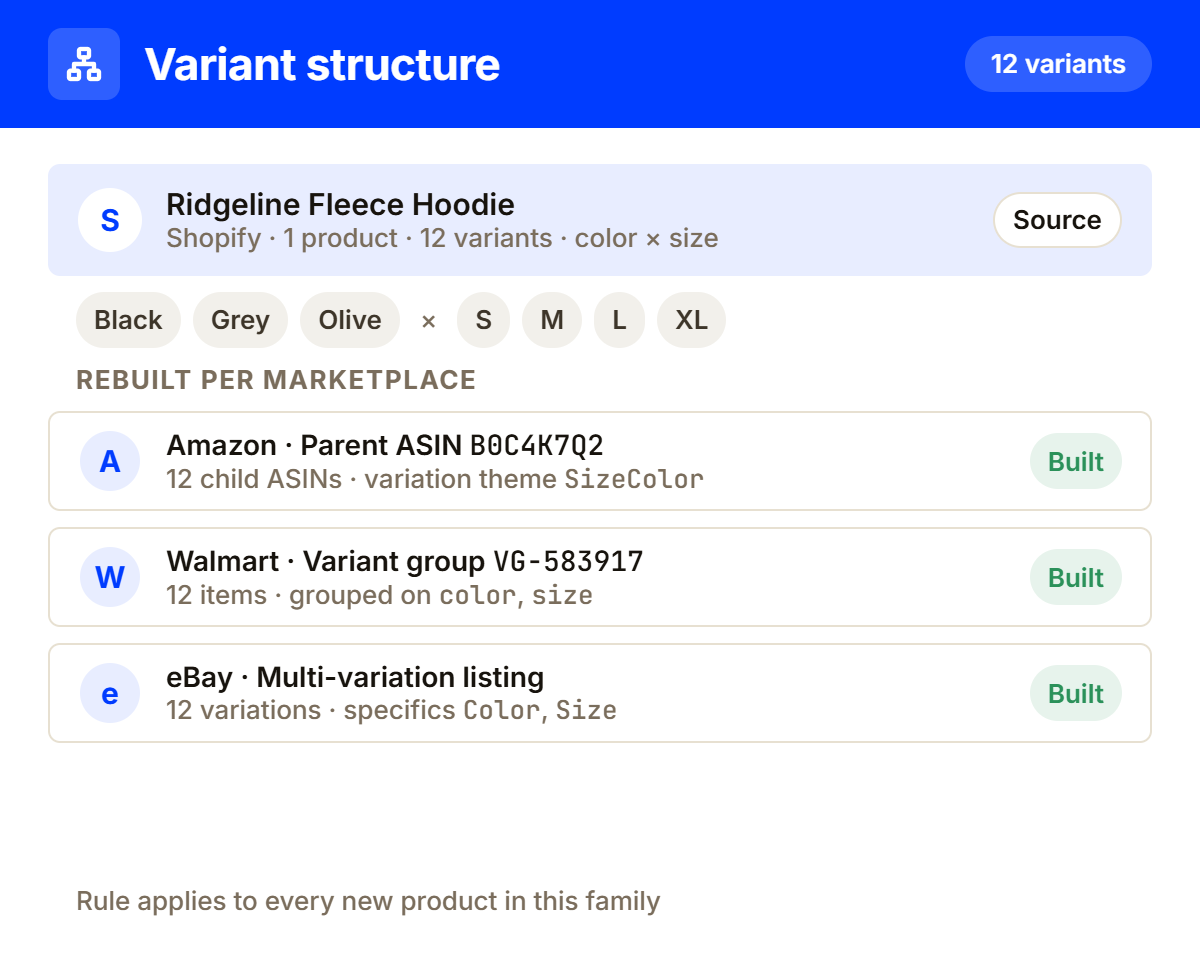
Your store holds one product with twelve variants. Amazon wants a parent ASIN with children under a valid variation theme, Walmart wants a variant group keyed on its own attributes, and eBay wants one multi-variation listing. Rules restructure the family once and apply it to each.
Map to the taxonomy
Category placement decides where a product surfaces and which attributes it must carry. GoDataFeed maps your product types to Amazon browse nodes, Walmart product types, and eBay categories, then fills the required attributes and item specifics for each.
See category mapping in the platform →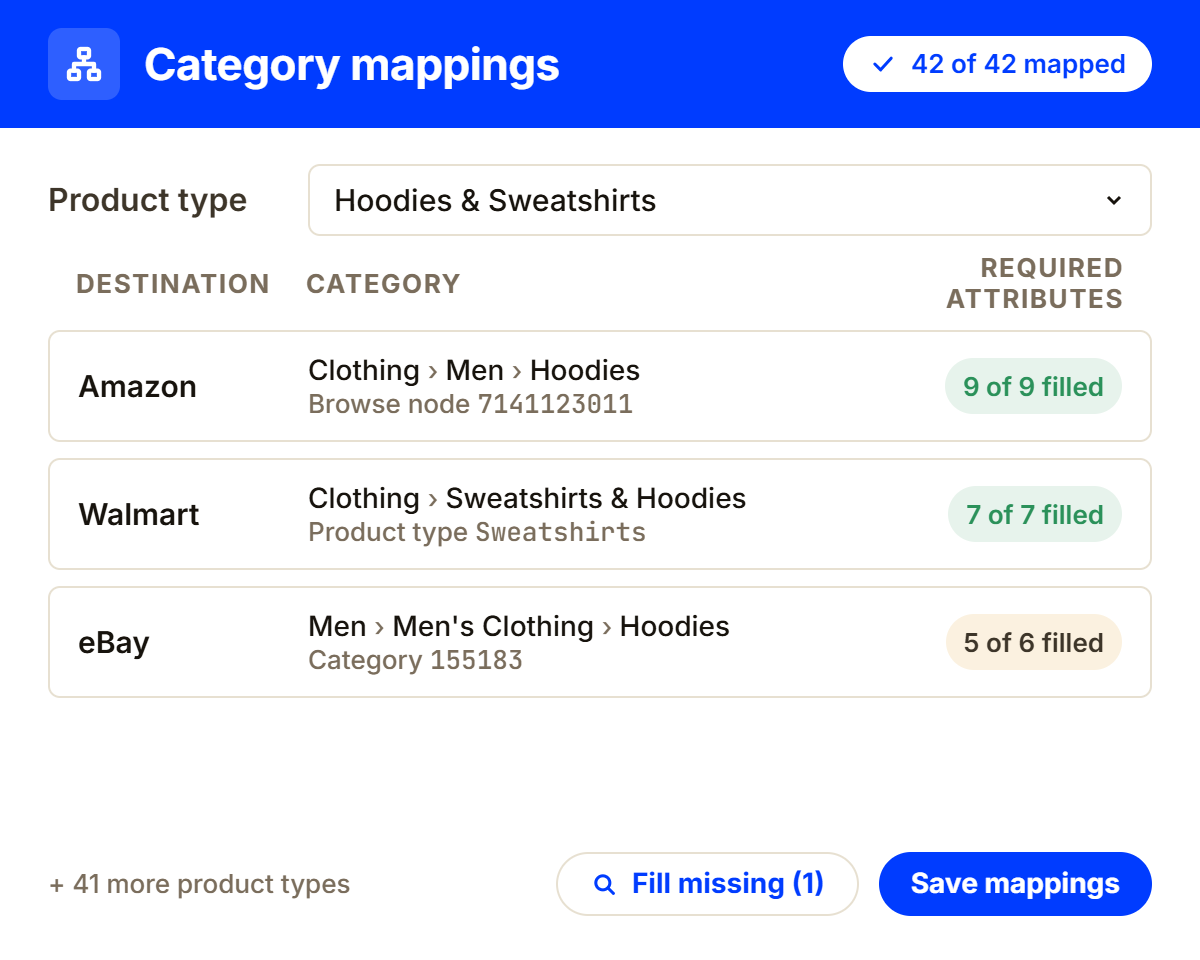
After the listing
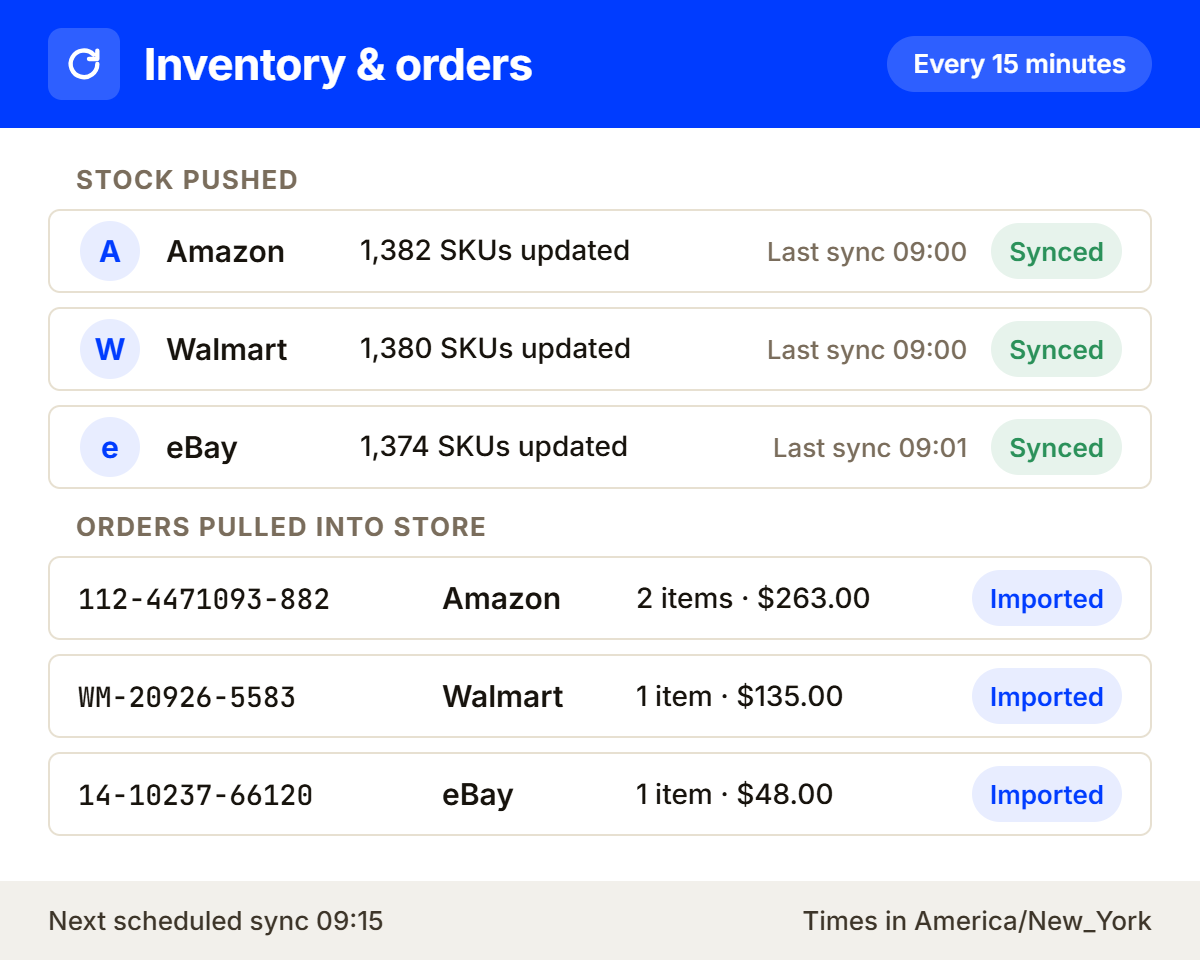
Overselling costs account health. GoDataFeed pushes stock levels to each marketplace on your schedule and pulls marketplace orders back into your store, so your team processes them alongside storefront orders.
One catalog, every marketplace
Amazon
Walmart
eBay
ASIN matching, browse-node mapping, parent-child variations, and category-specific attributes, with stock and order sync. Accurate offers protect the account health your Buy Box eligibility depends on.

Walmart grades item data with its Listing Quality score before shoppers see it. GoDataFeed maps your catalog to Walmart's item spec, fills the attributes that score measures, groups variants, and syncs stock and orders.
Best Match reads item specifics, identifiers, and category placement. Rules populate specifics per category across the catalog, structure multi-variation listings, and sync price, stock, and orders.
Store to listing

Pull your full catalog, variants, and inventory from any store or source.

Resolve identifiers against each marketplace's catalog before submission.

Rebuild variant families to each marketplace's parent-child model.

Place each product in its category and fill the required attributes.

Check listings against the marketplace's current spec before they ship.

Push stock, pull orders, and watch listing status from one view.
Two ways to run it
Same platform, same data quality. Pick the level of hands-on you want - and switch later without re-platforming.
Self-serve
Full access to mappings, rules, and channels. Preview a change on sample SKUs, then push it on your schedule. No ticket, no queue.

In-app editing for every product
200+ integrations, ad channels on every plan
Validation & alerts built in
Managed
A dedicated feed team runs day-to-day operations while you keep full visibility and the keys to your data.

Dedicated feed specialist
Proactive monitoring & cleanup
You still own and export everything
Proof
Automotive seller
BigCommerce merchant
Amazon seller
We've been using GDF for 4 years to fuel Google Shopping, Bing, Amazon and eBay accounts. I couldn't be happier with their product and their support.
4
years running Amazon, eBay, Google, and Bing feeds
Verified G2 reviewer, automotive
We did not have the time, resources, or expertise to manually maintain our dynamic product line in 3 separate locations (BigCommerce, Amazon, and Ebay). … GoDataFeed solved our problem.
3
stores kept current from one catalog
BigCommerce merchant, app marketplace review
We've been using GoDataFeed to manage our Amazon product feeds, advertising feeds, and other feeds for a few years and we absolutely love the tool. We switched from a competitor that was not nearly as powerful, more money, and required more of our attention to manage.
5/5
Shift4Shop app rating
Jordan Lindberg, Traverse City, Michigan
FAQ
Questions, answered
Automation can have a marketplace feed ready to submit in minutes. When our team builds it, setup usually takes one to two days; catalogs over 10,000 SKUs can take up to five business days. Connect Shopify, BigCommerce, Adobe Commerce, Salesforce Commerce Cloud, WooCommerce, or a file or API.
Yes. Orders from Amazon, Walmart, eBay, and Newegg sync back into your store, and stock levels push out on your schedule, so one inventory count drives all of them.
Yes. When a GTIN matches an existing ASIN, your offer attaches to it. When it doesn't, GoDataFeed flags the SKU and fills the attributes that category requires for a new listing.
We update the category template and its validation rules. Your rules keep running, and any SKU the change affects shows up in validation before the next submission, not as a suppression notice.
Amazon, Walmart, eBay, Newegg, Rakuten, Flipkart, and Houzz, plus others in the integration library. Each gets its own spec mapping from the same catalog.
Start a 14-day free trial, or book a demo and we'll audit your marketplace listings for free.