



















































Home / Solutions / Search Ads
Solution — Shopping & Search Ads
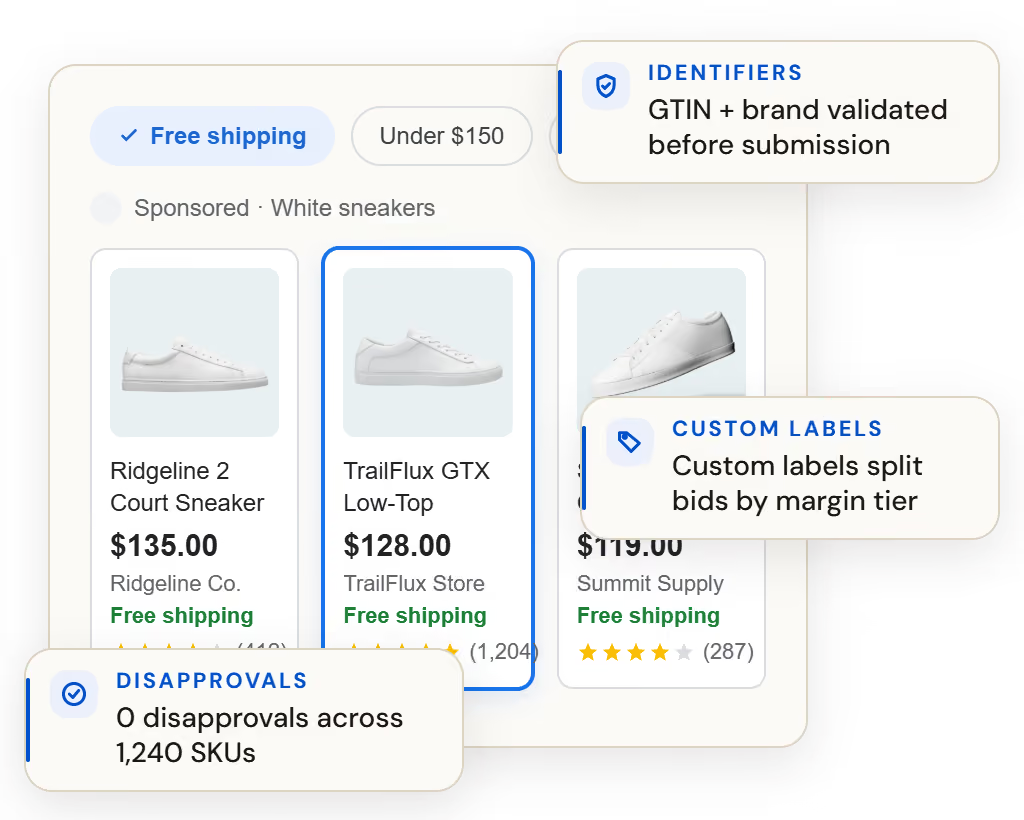
Google and Microsoft match shopping queries on your titles, segment bids on your custom labels, and drop any SKU that breaks spec. GoDataFeed rebuilds your catalog to each engine's requirements, fills the gaps, and validates every SKU before it reaches Merchant Center, so campaigns spend on products that can serve.
93%
of retailers running Google Shopping ads use Performance Max (Tinuiti, Q1 2025)
Up to 20%
higher conversion rates for products with correct GTINs (Google)
17%
year-over-year growth in Microsoft search ad spend (Tinuiti, Q1 2025)
How the catalog becomes the campaign
Map to spec
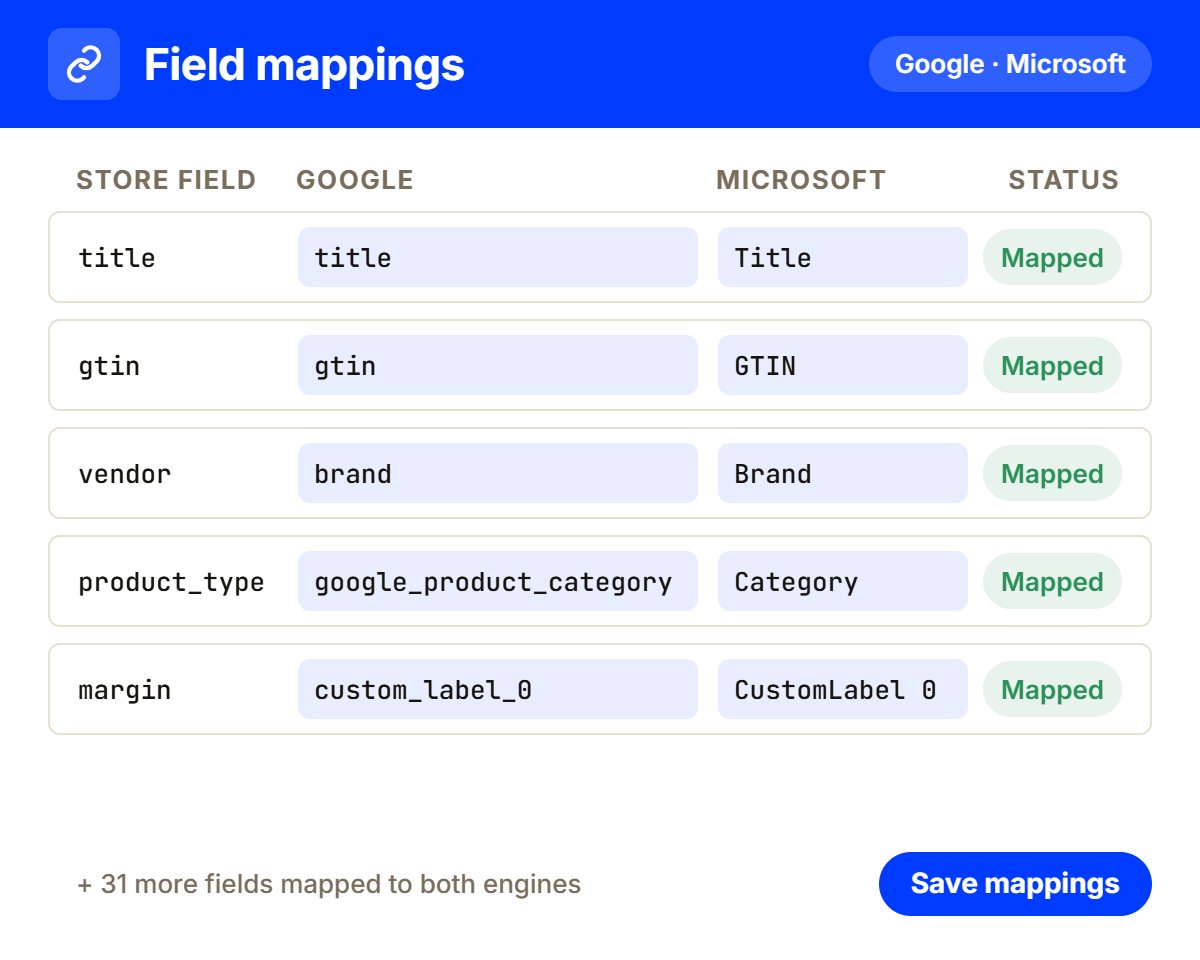
Google and Microsoft each want their own titles, identifiers, product types, and category taxonomy. GoDataFeed maps your catalog to both from one source and maintains the templates when a spec changes, so a Merchant Center update doesn't turn into a week of spreadsheet work.

Engineer what the auction reads
Titles with brand, product type, and variant attributes match the long-tail queries that convert. Custom labels encode margin, seasonality, and stock depth so Performance Max can separate core sellers from clearance. AI title suggestions go through your preview and approval, then the rules engine validates them before anything ships.
Validate before you spend
Pre-submission validation catches missing GTINs, malformed prices, and over-length titles before Merchant Center flags them. When a policy change hits thousands of SKUs, one rule change clears them together. Budget goes to products that can serve.
See validation in the platform →
One catalog, every auction
Google Shopping
Performance Max
Microsoft
Merchant Center spec, Google product categories, sale-price windows, and local inventory, mapped and validated so Shopping ads and free listings run on the same clean feed.
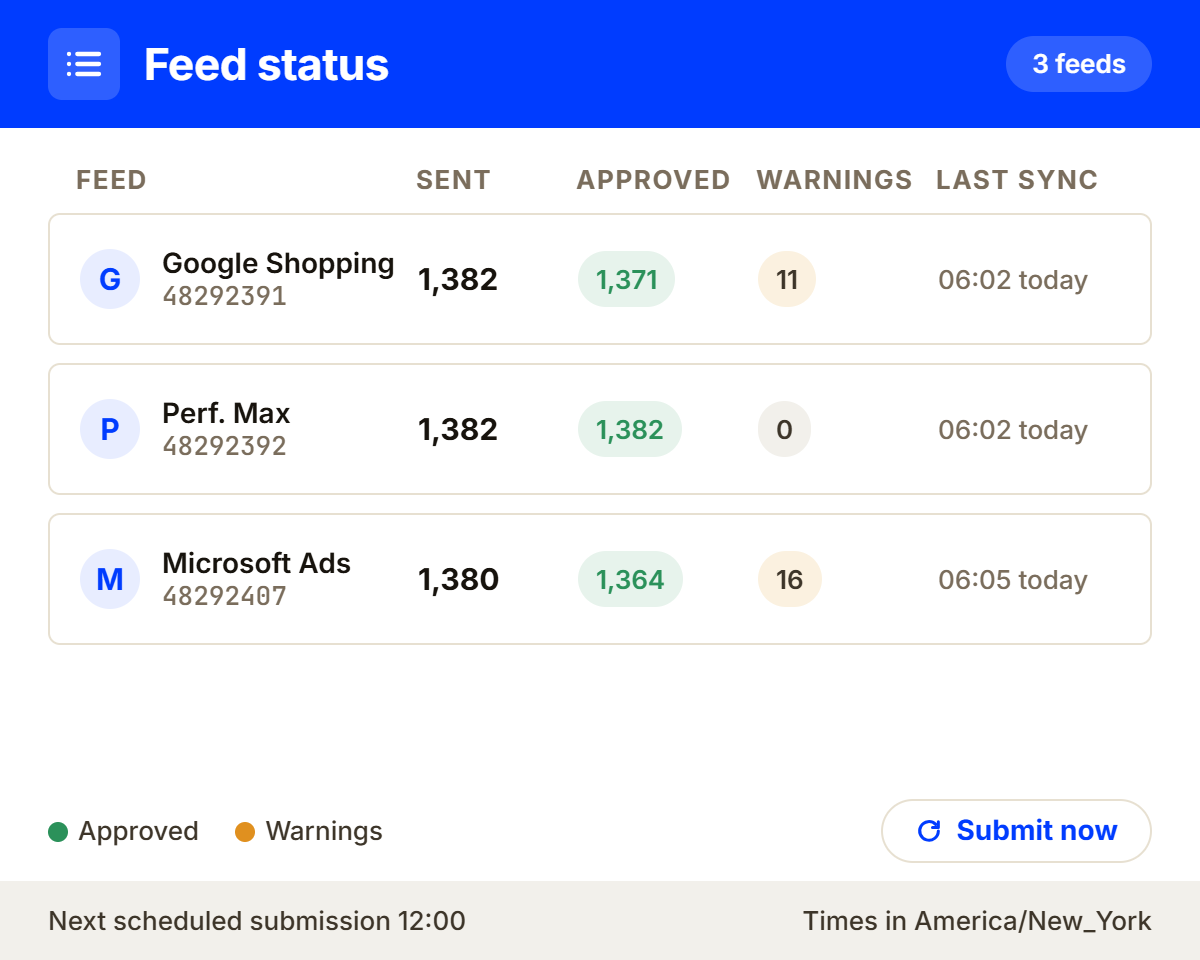
All five custom_label slots filled from catalog data, item_group_id kept intact so variants don't collide, and titles built for query matching. PMax and AI Max get inputs that reflect your strategy instead of a storefront export.
A Microsoft Merchant Center feed built to Microsoft's spec from the same catalog, not recycled from Google. The same feed carries your products into Copilot's shopping answers.
Store to served ad

Pull your full catalog, variants, and inventory from any store or source.

One clean master record, deduplicated and normalized.

Fill attributes and titles by rule, with AI suggestions you approve.

Shape each SKU to Google's and Microsoft's current spec.

Run each SKU against the rulebook before submission.

Publish, then monitor approvals and feed health from one view.
Two ways to run it
Same platform, same data quality. Pick the level of hands-on you want - and switch later without re-platforming.
Self-serve
Full access to mappings, rules, and channels. Preview a change on sample SKUs, then push it on your schedule. No ticket, no queue.

In-app editing for every product
200+ integrations, ad channels on every plan
Validation & alerts built in
Managed
A dedicated feed team runs day-to-day operations while you keep full visibility and the keys to your data.

Dedicated feed specialist
Proactive monitoring & cleanup
You still own and export everything
Proof
SEM director
Web director
Shopify store
Within four months of optimizing our feeds with GoDataFeed, we increased sales by $10,000 a month. … Easy-to-use analytics and rules get rid of products that don’t convert.
$10K
more in sales per month within four months
Dustin Mower, Owner and SEM Director
In the last year of working with GoDataFeed, our conversion rates have tripled. The software enhances our product descriptions with more search-friendly terms, attracting a wider audience.
3x
conversion rate in one year
Brenda Smith, Director of Web Development
We ran into issues with our Shopify-native Google Shopping feed where we couldn't assign MPNs to product variants. … With GoDataFeed we have the flexibility to make associations and adjustments as needed.
5/5
Shopify App Store rating
Cable Bullet, Shopify merchant
Start a 14-day free trial, or book a demo and we'll audit your Google Shopping feed for free.
FAQ
Our automation can have your Google feed ready to submit in minutes. When our team builds it, setup usually takes one to two days, and complex catalogs over 10,000 SKUs can take up to five business days.
The native channel sends store data as-is. It doesn't rewrite titles for query matching, fill custom labels, or validate SKUs against Merchant Center rules before submission. GoDataFeed does that work and leaves your store data untouched.
Yes. Rules fill all five custom_label slots from catalog data, such as margin band, season, price tier, or stock depth. Labels refresh on every sync, so listing groups follow the catalog instead of a manual export.
We update the Google and Microsoft templates and the validation rules behind them. Your rules keep running, and anything the change affects shows up in validation before it becomes a disapproval.
Not for ad and shopping channels. Every plan includes Google, Microsoft, and the other ad channels, so adding one adds no fee. Marketplaces such as Amazon, Walmart, and eBay need the Pro plan or higher, or a single-channel marketplace feed.