




















































AI agent
Make your products citable.
Perplexity’s shopping answers name products it can verify — identified, priced, in stock, and described in data a model can parse. GoDataFeed builds and maintains that data from the catalog you already run, in the Google Shopping format Perplexity ingests.
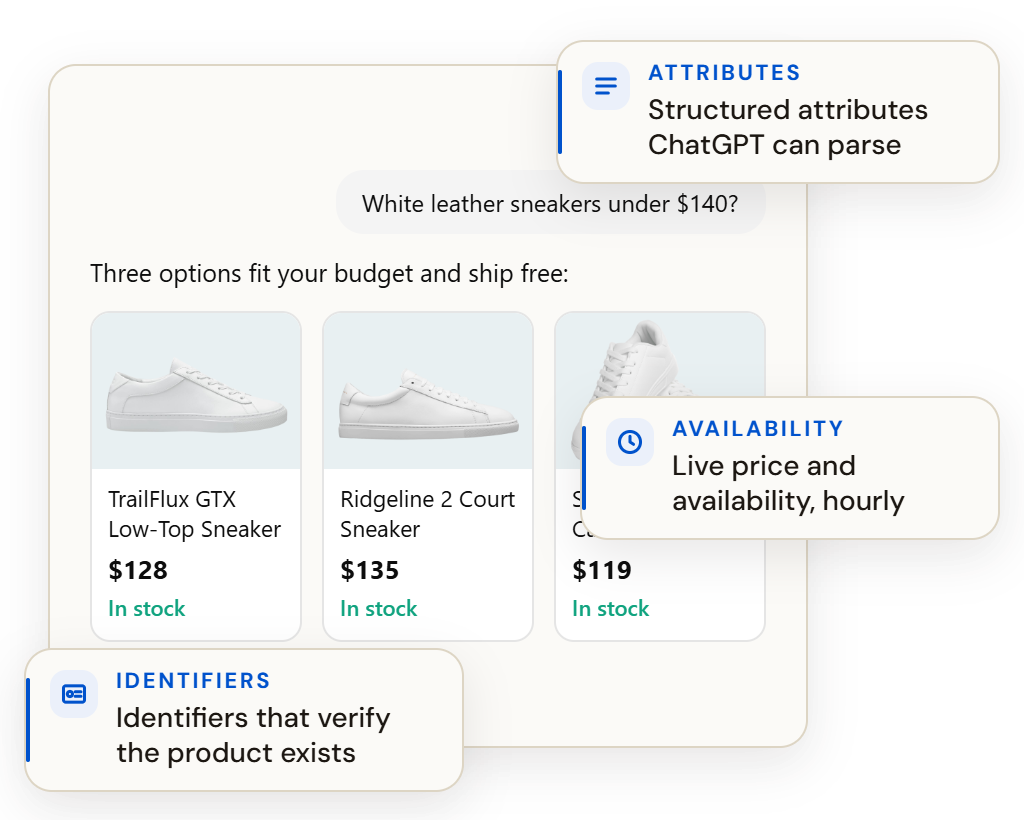
The short list
Ask Perplexity for waterproof trail runners under $140 and the reply is three or four products, each with a price, an availability status, and a source it can point to. That list is assembled from structured product data: the feed you submit, checked against what your product page says. The page you tuned for SEO still matters here as the thing Perplexity verifies against. The feed is what gets you considered.
Three things make it worth doing now. Listing is free; there is no paid tier to be included and no auction to win. The program is young and mostly unclaimed — the answer set in most categories is still open. And the feed Perplexity ingests is the one you already build for Merchant Center, so the work compounds: the same catalog fixes lift you in Google Shopping, Google AI Mode, and here.
Cited or skipped
The file it reads
Required
id — Stable and never recycled; mapped from your platform’s variant ID.title — Rebuilt by rule, brand, product, defining attributes, in the order a model parses.description — Attribute-rich plain text; AI enrichment runs with review before publish.link, image_link — Variant-specific URLs, reachable without a login.price (with currency), availability — Synced from your platform on schedule and validated before each publish.Required where it exists
gtin — GS1 check-digit validation; invented or recycled codes are flagged before they ship.brand, mpn — Required when no GTIN; mapped and validated as the fallback match.Recommended
condition, google_product_category, product_type — Category mapping by rule or AI categorization, with approval.item_group_id, color, size, material — Expected for apparel; variant structure preserved from your platform.shipping — Mapped from your platform’s rates.Required status follows Google’s Shopping specification; Perplexity hasn’t published a field list of its own.
GoDataFeed’s part — and yours
GoDataFeed builds, validates, delivers, and refreshes the feed. Enrollment in Perplexity’s Merchant Program is yours. No feed platform pushes to Perplexity directly — the program is the door, and the feed is what walks through it.
Rules rebuild titles and descriptions into the attribute order a model parses: brand, product, variant, material.
Price and availability sync from your platform and validate before each publish, so the feed and the page agree.
GTIN check-digit validation with brand + MPN fallback; invented codes are flagged before Perplexity sees them.
The same engineered catalog feeds Google Shopping, Google AI Mode, Microsoft Copilot, and 60+ channels. Fix it once.
How it works
01
Connect your store. Rules and supervised AI rebuild titles, descriptions, and categories; you approve before anything publishes.
02
Identifier, price, availability, and image checks run before publish. Failures surface with the fix, not just the error.
03
Once the Merchant Program approves you, give Perplexity the feed once. GoDataFeed delivers the file on your schedule from then on.
Thirty minutes, live, on your data — the mapping, the rules, the validations, the fix list. Or watch the demo tour first: the recorded version, no meeting required.
Questions, answered
How does Perplexity find products?
From structured product data: the feed you submit through the Merchant Program, verified against the product page it cites. Allow PerplexityBot and keep your page’s product schema in step with the feed.
Do I need a Perplexity-specific feed?
No. Perplexity takes a Google Shopping–compatible feed file. If you already build one for Merchant Center, GoDataFeed delivers a copy to Perplexity; if you don’t, it builds one. No Merchant Center account required.
What makes a product citable?
Complete attributes, a valid GTIN (or brand + MPN), and a price and availability that match the page Perplexity cites.
Does GoDataFeed connect directly to Perplexity?
No, and no feed platform does. GoDataFeed builds, validates, delivers, and refreshes the feed; you hand it to Perplexity once through the Merchant Program. Enrollment and any checkout program are yours on Perplexity’s side.
Does it cost anything on Perplexity’s side?
Listing is free. No paid Perplexity plan or advertising arrangement is required to be included.
Go deeper
At a glance
Type
AI agent
Connection
Merchant enrollment
Feed format
Google Shopping–compatible feed file (CSV or XML)
Refresh
Once a day to every 5–15 minutes, by plan
Order sync
No
Plan
All plans
Identity key
GTIN; brand + MPN where no GTIN exists
Before you start
Approval in Perplexity’s Merchant Program. No Google Merchant Center account required.
Note
GoDataFeed builds and delivers the file on schedule; you enroll and hand Perplexity the feed. Free for merchants.
GoDataFeed optimizes, enriches, validates, and keeps your product data in sync across Google, Meta, marketplaces, and AI shopping.