



















































Marketplace
not effort.
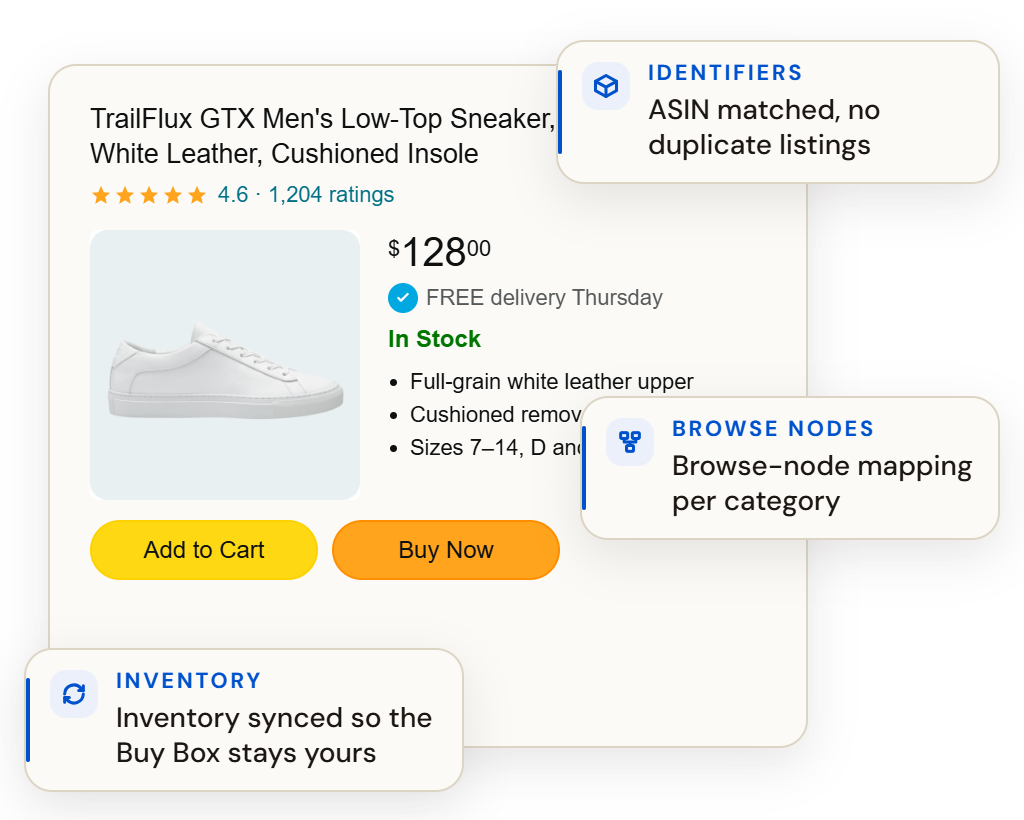
Listings live or die on identifiers, browse nodes and attribute depth. GoDataFeed maps your catalog to Amazon’s category specs, validates every field and keeps offers accurate - at catalog scale.
What the algorithm reads
Browse-node placement, attribute completeness and identifier accuracy determine where products surface. Weak item data does not rank low - it fails to enter the paths shoppers browse at all.
Products place into the right nodes by rule, so they surface where shoppers actually look.
UPCs, EANs and ASIN matching validated across the catalog before submission.
Required and recommended fields populated per category, across the full catalog.
Price and stock sync on schedule, protecting account health and the offer that wins the Buy Box.
How it works
01
Your full catalog imports automatically with variants, imagery and inventory.
02
A maintained template covers categories, identifiers and required attributes; your rules refine them.
03
Validated listings push on schedule with feed health tracked in one dashboard.
Thirty minutes, live, on your data — the mapping, the rules, the validations, the fix list. Or watch the demo tour first: the recorded version, no meeting required.
1
catalog behind Amazon and every other channel you sell.
60+
channels one connection can feed.
0
listings suppressed for data a rule could have fixed.
Questions, answered
How does ASIN matching work?
Amazon matches your products to existing ASINs by identifier. Validated UPCs and EANs match correctly - malformed ones create duplicates or errors.
What suppresses listings?
Missing required attributes, identifier conflicts and stale offers. Validation and scheduled syncs address all three.
How do offers stay accurate?
Price and stock sync on your schedule, so your offer reflects what you can actually fulfill.
Go deeper
At a glance
Type
Channel
Connection
Feed format
Refresh
Order sync
Yes
No
Plan
Identity key
Before you start
Note
GoDataFeed optimizes, enriches, validates, and keeps your product data in sync across Google, Meta, marketplaces, and AI shopping.