



















































Product feeds were built to answer one question for the channel: what is this product, and which searches should it match? That job is not going away. But once the shopper stops typing a keyword and starts describing a situation, the channel needs more than a match. It needs enough evidence to decide whether the SKU fits the request, and most feeds were never structured to supply it.
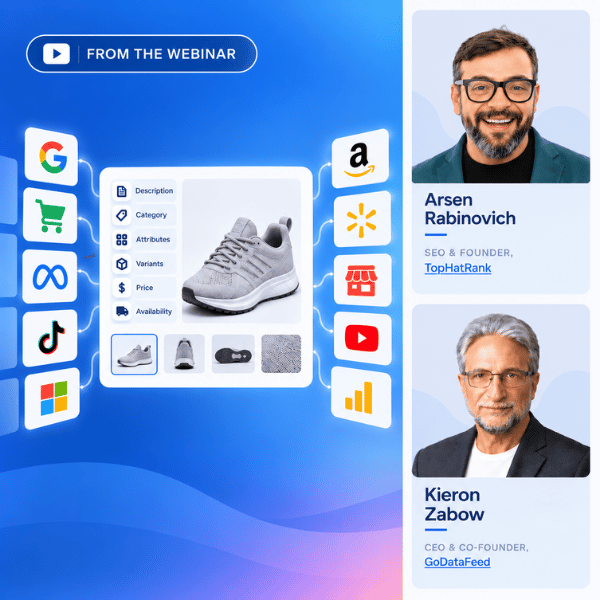
That shift was the subject of Duda's webinar The New Era of Search: Winning Agentic Commerce with Data Feeds, where SEO strategist Arsen Rabinovich sat down with GoDataFeed co-founder Kieron Zabow. Arsen came at it from the search side. Kieron worked backward from the product data.

Kieron opened with one of GoDataFeed's earliest merchants, a New York seller of fur hats with products people wanted and no online traction. The team changed one word in the product titles, "fur hat" to "winter hat," and sales took off. That was feed optimization in its original form: figure out how people search, then describe the product in the terms the channel can match to demand.
Arsen pushed the same idea into the way people are starting to shop with AI: a carry-on under $250 that works for weekly business travel, has a laptop compartment, is not black, and will arrive before Friday. Price, color and availability are attributes you already know how to structure. "Works for weekly business travel" is not an attribute, "fits a 16-inch laptop" is a fact you probably know but have never sent, and "arrives before Friday" moves the recommendation out of product content and into fulfillment.
Kieron described the modern feed as a translation layer between the merchant catalog and the systems trying to sell those products. Early on the team thought of it as the CMS of product listing ads. Now, in his words, it is "more like a knowledge base of a product that informs the AI engines with enough context and content so that they can calculate whether an item solves a hyper-specific human scenario."
Most merchants still hear "product feed" and picture a spreadsheet sent to Google, Amazon or Meta. Kieron's point was that before anything is transmitted, the feed is applying hundreds of decisions to the catalog: which products go to which channels, which are running low, where the discounts are, which category each item belongs in, and when a product comes off a channel because it stopped performing.
Custom labels are the clearest example of why that matters for campaigns. Kieron described them as the mechanism that sorts products into groups inside Google Ads, so you can run "a high bidding group for your top performers" and "a penny bid for your zombie products." The label is set by feed logic, and the bid strategy inherits whatever the label says. If the logic is stale, the campaign is optimizing inside groups that no longer reflect the business.
His shoe retailer case shows the same failure at the SKU level: about 116,000 pairs organized into families by size and color. The retailer was bidding on product groups where the core sizes, roughly 8 through 12, had sold out, while the twos and fourteens kept the family "available," so most of the spend was landing on inventory almost nobody buys.
That might look like an inventory problem, but it is a segmentation problem. Google saw an in-stock family. The retailer knew it was, in practical terms, gone, so GoDataFeed built a rule type that pulls those families down. That protects Shopping and Performance Max spend today, and when an agent is checking whether a product satisfies a buyer's constraints, it keeps your listing out of a comparison it cannot win.

Kieron used furniture catalogs as the plain case: a sofa's exact dimensions buried in the description, never broken into length, width, and height fields a platform can process. GoDataFeed ended up writing regex to pull them out of description text because merchants assumed the feed was fine. It passed validation, and Kieron's point was that Merchant Center checks format, not usefulness.
A valid feed is not an informative feed. The gap gets wider past standard specs. The manual says the compartment fits a 16-inch laptop, customer service knows which laptops fit because shoppers ask every week, and reviews surface use cases the merchandising team never wrote into the catalog. Your organization knows all of this. Your feed says "carry-on, blue, $229."

Google has been making structured room for that knowledge through product_highlight (Kieron compared it to an Amazon bullet) and product_detail, and at Google Marketing Live 2026 it added six conversational attributes on top: question_and_answer, document_link, related_product, item_group_title, variant_option and popularity_rank. Kieron's count was "about eight," which in practice is those six plus the two that predate them.
Do not treat those as new places to repeat the same keywords. Google's guidance says not to duplicate what is already in description, product_highlight or product_detail, and Kieron was explicit that keyword stuffing is the wrong model. His test was whether the data is useful to the engine: "this jacket will keep you warm in the rain" does more than "waterproof," "certified waterproof," or "water resistant."
"Will this fit my 16-inch laptop?" is not a keyword opportunity. It is a product-data question, and it changes how you audit a feed: instead of asking which required attributes are missing, ask what your team knows about the SKU that the feed still cannot say. Bryan Falla made the broader case in When the Storefront Isn't a Store.
Everything above is mostly static. Kieron drew the line precisely: "the closer you get to the transaction, the more real-time and dynamic the data becomes." Price, inventory, promotions, handling time, and cutoff time sit on the other side of that line, and errors there produce returns, bad reviews, and the order that never arrives.
Arsen's carry-on can meet every product requirement and still be the wrong recommendation because it cannot arrive before Friday. Kieron's cutoff example: two-day shipping ordered at 3:30 when the cutoff was 3:00 is no longer two-day shipping, and Friday becomes Saturday. Update cadence follows the same logic, and it is not "every 15 minutes." He backs into it from sales velocity: a SKU that sells one every two hours needs price and inventory refreshed on a different schedule than one that sells five a day.
None of that requires agentic commerce to be worth doing. All of it gets more expensive to get wrong when an agent is comparing your listing against three others under the same delivery constraint, and the mechanics have not changed because AI entered the conversation. The cost of bad data has.

You still need clean identifiers, useful titles, normalized attributes, correct variant relationships, current inventory, custom labels and assortment rules. What changes is the cost of each failure when the request is this specific. Kieron's GTIN rule was blunt: submit a valid one if it exists, and if it does not, submit nothing rather than something wrong.
The protocol layer will keep moving underneath. Google's UCP-powered checkout is in early access and requires merchants to qualify, and OpenAI pulled native Instant Checkout out of ChatGPT in March 2026. Bryan covered why that churn does not change the merchant's job in Surviving Agentic Checkout: Why Product Data Is the Only Protocol You Control.
Arsen framed agentic checkout as close. Kieron's advice for merchants with limited time was more conservative: start from the bottom, get attributes, variants, pricing, titles and descriptions correct first, because the richer attributes are built from them. "I wouldn't jump straight into all these Q&A attributes and PDFs."
The sequence reconciles them. Take the products already driving your Shopping spend and write down the questions a customer asks when they are close to choosing: Will this fit my 16-inch laptop? Can this arrive before Friday? Which variant fits my use case and is actually available? Then answer them using only the data you send through the feed, not the PDP. Where the feed cannot answer, find where the fact lives and whether it can be sent in a structure the channel can use. If the basics under it are broken, fix those first.
Arsen's last real question was what happens when several systems disagree. Kieron's answer was that it is an organizational problem before it is a technical one. Who owns the feed? Often one person is responsible for inventory, another for descriptions, a third for promotions. Then inventory arrives from the ERP and from Shopify with different numbers, and something has to decide which source wins.
No conversational attribute fixes that, and no checkout protocol does either. It is the constraint that stays in place after everything else here is clean.
The old feed helped machines find the product. The new feed has to help machines know when to choose it, and that starts with deciding, inside your own organization, what the feed is allowed to say.
Watch the full conversation: The New Era of Search: Winning Agentic Commerce with Data Feeds.
Carlos Rodriguez is a seasoned content marketer with a background in marketing and advertising. Formerly at the helm of his own marketing agency, he now dedicates his expertise to guiding ecommerce merchants and marketers in mastering multichannel strategies. Outside of work, Carlos is an avid reader and hiker, often found traversing the mountain ranges of Cundinamarca like El Quinini.
Run a free feed audit and see which of your titles are matching queries you'd never choose to bid on.