





















































A customer sees your product in an Instagram Reel and taps through to your site. A different customer watches a creator using it on TikTok and buys without leaving the app. A third finds a Reddit thread where someone recommends it by name, clicks a link in the comments, and lands on a retailer they've never heard of.
Three purchases. Three entry points. None of them started at your homepage.
This isn't an edge case — it's the default shape of an ecommerce day. The direct-to-site stacks most retailers built their operations on weren't designed for it.

The storefront was the funnel. The merchandising logic, promotions, product display rules, checkout flow — all lived inside its architecture.
Headless commerce challenged that model years ago by decoupling the front-end from the back-end. But "headless" was a topic for devs, not marketing or retail operations. The business case wasn't obvious until the front-end fragmented.
Now brands are selling through TikTok Shop, Google Shopping, Amazon, Instagram Checkout, and affiliate-driven traffic from forums and groups.
Over 66% of consumers use two or more channels before completing a purchase. - Manhattan Associates
The operational problem that creates is specific.
Manhattan Associates' 2025 and 2026 omnichannel reports flag it directly: legacy architecture can't flex fast enough to serve new buyer entry points.
The bottleneck isn't logistics or fulfillment. It's the inability to push the right version of a product to the right surface, quickly.
Google Shopping wants specific title structures and GTIN-matched data. TikTok Shop has its own feed schema and surfaces products through a discovery algorithm that weights video engagement. Amazon enforces strict attribute templates by category. A Walmart Marketplace listing that performs well looks nothing like the PDP.
Some channels forgive that. Others quietly deprioritize listings that don't meet their format expectations.
BigCommerce's 2025 trends report points to API-first platforms as central to serving modern ecommerce. But architecture alone doesn't solve the catalog problem.
Most brands have thin product data. A title, a price, a few images, a brief description. That's enough to render a product page. It's not enough to win placement on channels that use attribute completeness and relevance as ranking inputs.
Manhattan Associates puts a number to the gap: retailers with advanced catalog maturity achieve median conversion rates of 2.4–2.1%, against 1.0% for their basic-maturity peers.
The gap isn't in the data that's wrong. It's in the data that was never written, or written with a different context in mind.
Brands have begun adapting their delivery format for TikTok Shop, Google Merchant, and mobile-native UX. Adapting the delivery format is only half the problem.
The other half is the content inside the feed.
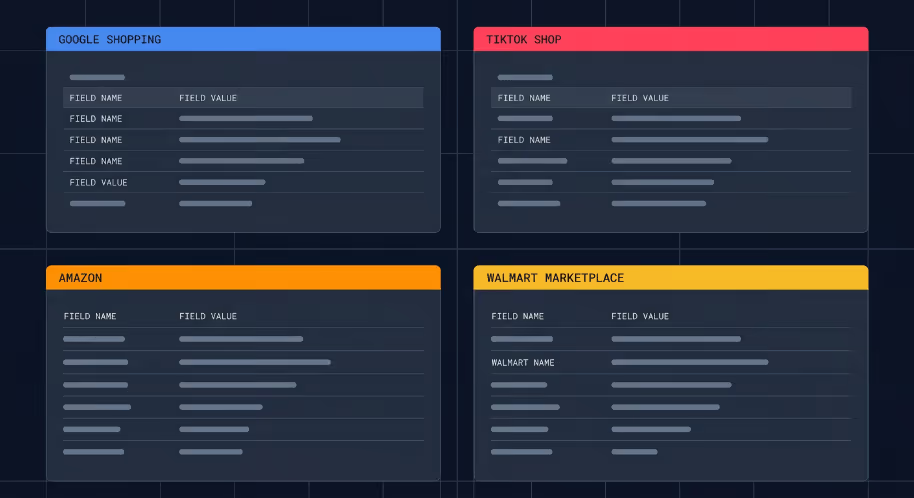
Channel-specific formatting gets your listing in front of the algorithm. Semantic depth gets it in front of the buyer.
GoDataFeed's position in this environment is specific. The platform doesn't just map and distribute feeds. It adds the semantic layer that most source catalogs are missing.
That means injecting product-use context into titles, descriptions, bullet points, product highlights, and attribute fields that influence placement algorithms. Information that lives in the product team's knowledge base, in customer FAQs, in support tickets, in the reasons people actually buy, but that was never encoded into the feed.
It also means surfacing FAQ-derived content as structured attributes.
Questions like "Is this dishwasher safe?" or "Will this fit a King mattress?" show up constantly in search queries and channel filters. Sellers that have those answers inside their product data have a structural advantage on every channel.
There's a lot of strategic energy going into composable commerce and API-first stack decisions right now. Those decisions matter. But they create the plumbing, not the content inside the pipes.
The channels that make up the fragmented front-end are reading product attributes to make placement decisions. Richer, more specific, contextually accurate product data wins more of those decisions regardless of the platform serving them.
Here's how that plays out, channel by channel.
Google Shopping is still the baseline. For most retailers, it's the first channel they optimize and the one that drives the most measurable return.
The infrastructure is Merchant Center, where feed quality isn't a compliance issue. It's a ranking input. Google's algorithms use product attributes — titles, descriptions, GTINs, product type taxonomy, custom labels — to determine placement.
A technically valid listing and a well-optimized listing are not the same thing. One passes policy review. The other competes for placement.
The difference is usually in the data that wasn't required but mattered:
Microsoft Advertising runs on the same basic architecture as Google: a Merchant Center feed powers Shopping campaigns, smart bidding automates placement decisions, and product listings appear on commercial-intent queries.
For retailers already running Google Shopping, the lift to activate Microsoft is low. The feed structure is similar enough that most catalog management platforms can syndicate to both from a single source.
The immediate appeal is economics. Bing's search volume is a fraction of Google's, and so is the advertiser competition. CPCs on comparable Shopping queries run consistently lower, and auction density is thinner.

But the more significant Microsoft story in 2026 isn't CPCs or demographics. It's the Bing index feeding ChatGPT's product recommendations.
The limitation Microsoft shares with Google is the same: search-based channels can run out of road. Search captures intent. Social creates it.

A shopper who didn't know they wanted a linen duvet cover sees one styled in a bedroom Reel, taps the product tag, and is three steps from checkout without ever searching for a product.
Meta's platforms reach more than three billion monthly active users across a demographic spread no other social property matches.
Meta Commerce Manager is the infrastructure behind both. A single feed powers Dynamic Product Ads, Shop storefronts on both platforms, product tags in organic posts and Reels, and the automated retargeting that follows a browsing session across Meta's surfaces.
The demand creation side is where Meta still has structural advantages other platforms are working to replicate. Interest-based and lookalike targeting lets brands reach buyers who match the profile of existing customers before those buyers have signaled any purchase intent.
Combined with shoppable post formats that compress the path from discovery to product page, the funnel can be genuinely short.
Then it gets complicated.
Meta controls the Shop storefront experience, the product display format, the checkout flow when native checkout is enabled, and the algorithm that determines which products get organic visibility.

Feed quality affects all of it, but it isn't the only factor.
The Shops storefront experience inside the app is functional, but destination shopping behavior — the kind where someone opens a brand's Shop tab to browse — isn't how most users engage on either platform.
On Facebook and Instagram, product discovery is incidental to content consumption. Feed-to-purchase conversion depends heavily on the creative quality and context of the content tagged with products, not just the product listing itself.
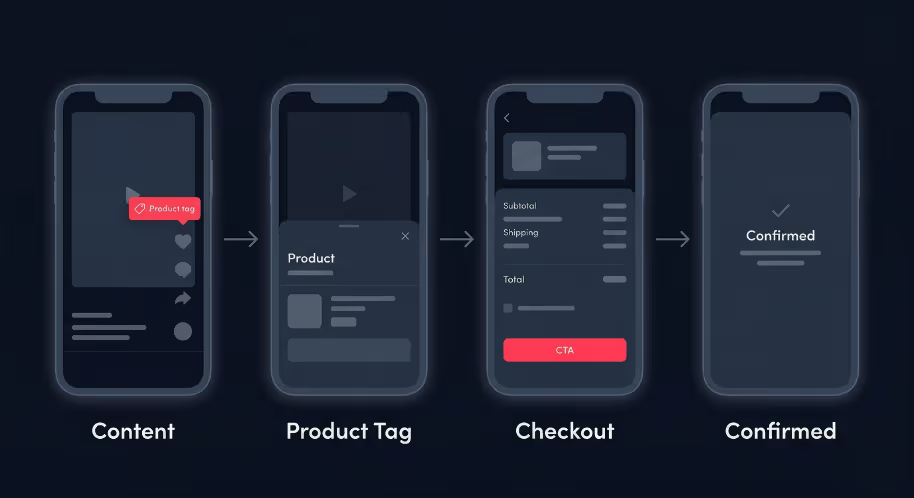
Meta built a social platform and added commerce to it. TikTok built a content algorithm and made the content shoppable.
That's not a subtle distinction. It changes the entire relationship between product discovery and purchase intent.
On TikTok, the product link lives in the content. A user who hadn't considered buying a product thirty seconds ago is now three taps from checkout, without leaving the app, without searching, without encountering a traditional ad at any point in that sequence.
That's a different funnel path than anything search or legacy social delivers.
TikTok Shop runs on a product catalog feed with its own schema requirements:
The feed powers the seller's Shop, shoppable video tags, LIVE Shopping integrations, and TikTok's own ad products, including Video Shopping Ads and Catalog Listing Ads.
TikTok's content distribution doesn't work like Meta's interest targeting or Google's query matching. It's behavioral and iterative. The platform observes what a user watches, replays, and engages with, then adjusts what it serves next. A product that appears in content earning strong engagement gets distributed further. Organic reach on TikTok still carries real value in a way it hasn't on Instagram for years, and that reach is directly shoppable.
The limitations are real and worth naming. TikTok's user base skews younger than any other major commerce channel, which matters for category fit:
TikTok creates intense, short-duration purchase intent in a passive consumption environment. It sells to buyers who didn't know they were shopping.
What it doesn't do well is serve a buyer who already knows what they want and is doing research before committing. For comparison shopping, reading reviews, and weighing specifications, buyers don't go to TikTok for answers. They go to Reddit.

Reddit doesn't look like a commerce channel. There's no native checkout, no shoppable post format, no creator affiliate program built into the feed.
The buyer on Reddit is in active research mode — past the awareness stage. They know the category, they've probably already seen a product on Instagram or TikTok, and now they want unfiltered peer validation before they commit.
Reddit's voting and threading mechanics surface the most credible, most agreed-upon recommendations to the top of any given thread. When a product earns genuine organic recommendation density in a relevant subreddit, that signal carries more purchase-stage weight than almost any paid placement. It's the closest thing digital commerce has to word-of-mouth at scale.
For brands, the organic play on Reddit is slow and has to be earned. Subreddit communities are aggressively intolerant of promotional content that doesn't add value.
The paid side is where the immediate opportunity sits for most retailers right now, specifically through Dynamic Product Ads.
Reddit's DPA product works similarly to Meta's. Listing content and creative pull directly from feed attributes. The catalog feed powers automated ad units that match products to users based on behavioral signals, browsing history, and interest graph data.
But Reddit's targeting carries a signal quality Meta can't match: it knows what topics a specific user spends time in. r/Homebrewing. r/CampingandHiking. r/BudgetAudiophile. These aren't demographic inferences or lookalike modeling. This is observed behavior in a defined space.
For brands in categories with strong Reddit communities, that targeting precision provides more signal than an interest-based Facebook audience can.

Every channel covered so far operates on some version of the same mechanic: a platform controls the distribution, sets the algorithm, owns the audience relationship, and charges for access to it.
Affiliate marketing inverts that model. ShareASale and CJ Affiliate are networks, not channels. Their infrastructure connects brands with publishers — product-review sites, deal aggregators, industry publications, niche content creators — who promote products in exchange for a commission on completed sales.
The default cost structure is purely performance-based. No CPCs, no CPMs, no minimum spend thresholds, no auction dynamics driving up the floor. A brand running an affiliate program through CJ pays commission on revenue it already received. That risk profile is fundamentally different from every paid channel in the mix.
The reach is also qualitatively different. A well-placed editorial review on a high-authority publisher can drive purchase-intent traffic that no paid campaign replicates at the same cost. Think Wirecutter, Rtings, or any niche vertical site that has spent a decade accumulating SEO equity in a specific category.
CJ and ShareASale both provide the network infrastructure: tracking links, commission management, publisher recruitment tools, and reporting dashboards that attribute sales to specific publishers and placements.
CJ has historically been stronger with enterprise-tier brands and large publisher relationships. ShareASale (now owned by Awin) runs deeper into the mid-market with a larger pool of niche publishers across long-tail categories.
For most retailers, the choice of network is less important than the quality of the program built inside it: commission rates competitive enough to attract serious publishers, creative assets that give publishers something to work with, and a product feed structured well enough to power dynamic placements where the network supports them.
The front-end of ecommerce is now wherever a buyer happens to be when intent forms.
These channels share almost nothing in terms of audience behavior, purchase mechanics, or attribution logic. What they do share is that every one of them uses product data to decide what to show, to whom, and in what context.
Sellers that treat the catalog as a backend maintenance task will lose placements, lose ranking signals, and lose conversions, one channel at a time. The sellers that close that gap don't do it by picking better channels. They do it by building better data feeds.
Bryan is a digital marketer with roots in journalism and creative writing. Over the past decade, he's helped hundreds of online retailers develop and implement ecommerce marketing strategies. When he isn't educating retailers on ecommerce, he's out exploring South Florida and stalking local breweries.
Run a free feed audit and see which of your titles are matching queries you'd never choose to bid on.
