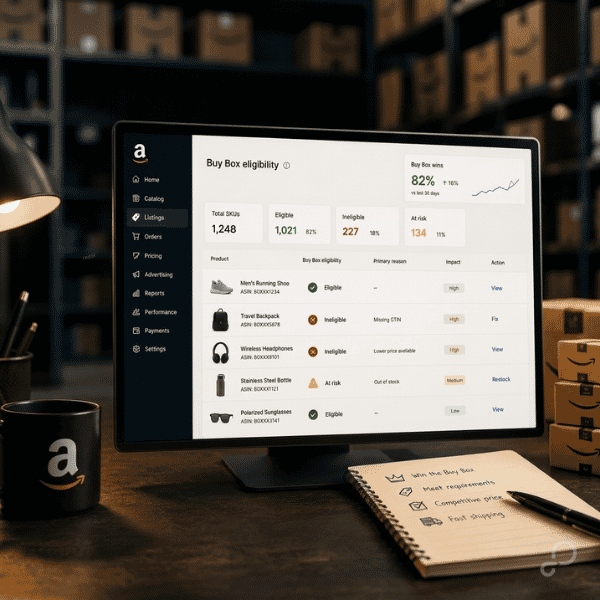




















































Amazon is sunsetting the Boolean eligibility gate for the Featured Offer, replacing the binary pass/fail performance screen with a continuous, unified ranking algorithm.
Amazon confirmed it is removing the standalone seller-performance eligibility check that previously gated access to the Featured Offer known as the Buy Box.

The prior architecture ran two stages. First, a Boolean eligibility filter screened sellers on performance. Second, the final formula ignored that telemetry, resolving the winner on price and delivery. Pass the filter, and your metrics stopped weighting the outcome.
Amazon collapsed those two stages into one. Seller performance telemetry — Order Defect Rate, chargeback rate, customer complaints — no longer functions as a gate. Amazon tracks that telemetry natively in Seller Central; it is account-level, not feed-submitted. Under the new model, those account signals become weighted inputs inside the same ranking formula that scores feed-level controls like price, fulfillment latency, and delivery speed. One pass, not two. Amazon's stated reason: the initial eligibility step "is no longer delivering additional value to customers." Rollout runs marketplace by marketplace through the end of 2026, and the exact weighting stays unpublished.
One way to look at it is this loosens the field so that more sellers get considered. Another way to look at it is through the mechanics of it: Amazon converted a static threshold you cleared once into a continuous weight you compete on for every offer. This architectural transition alters the operational leverage. When eligibility was Boolean, clean data cleared the filter and price took over. Under a unified formula, the accuracy of your feed-level attributes weights rank directly, on every ASIN, on every refresh.
Distinguish the two data classes, because they now interact. Account-level telemetry — ODR, complaints — sets the performance baseline Amazon carries into the auction. Feed-level attributes decide the rest. When two accounts carry similar defect rates, the algorithm relies on granular feed telemetry — specifically fulfillment latency and landed cost — to resolve the ranking. Stale leadtime-to-ship values and mismatched attributes are no longer shielded by the eligibility gate; they are live negative weights in the auction.
Compliance versus competitiveness: feed architecture is no longer a static compliance requirement you satisfy and forget. It is a continuous weighted input, scored against every competing offer.
Three operations follow while the weighting stays opaque.
If you need help automating your feed operations, contact us. We help thousands of sellers just like you make sense of Amazon’s data requirements.
Bryan is a digital marketer with roots in journalism and creative writing. Over the past decade, he's helped hundreds of online retailers develop and implement ecommerce marketing strategies. When he isn't educating retailers on ecommerce, he's out exploring South Florida and stalking local breweries.
Run a free feed audit and see which of your titles are matching queries you'd never choose to bid on.