




















































Artificial intelligence is reshaping online retail with hyper-personalized shopping experiences. But behind the scenes, its success hinges on something far less flashy.
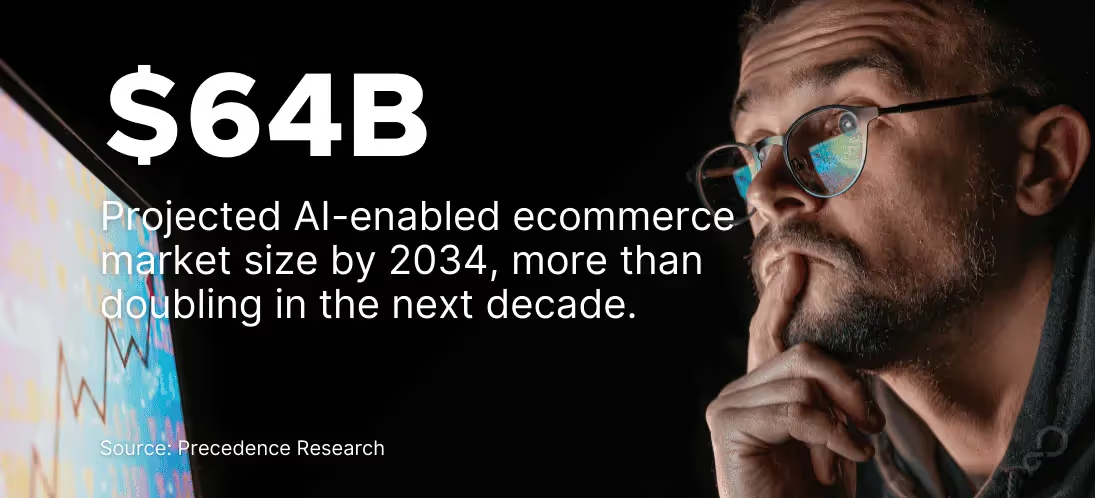
As AI-powered personalization becomes a standard expectation rather than a competitive edge, ecommerce brands are racing to implement algorithms that can recommend the right products to the right customers at the right moment. By 2034, the AI-enabled ecommerce market is projected to hit $64.03 billion, growing at a CAGR of 24.34% from 2024 to 2034, underscoring the rapid adoption of AI to fuel personalized shopping experiences.
Here’s a truth about AI most people ignore: AI is only as good as the data it works from. The smartest recommendation engine in the world won’t recommend your product if it considers your information outdated, incomplete, or inconsistent product information. Every product suggestion, every personalized search result, every dynamically generated landing page depends on a steady pipeline of accurate and current product data.
Ecommerce brands that are still struggling to maintain that pipeline won’t be miraculously saved by AI.
Despite the release of built-in content APIs like the Google & YouTube app, many of these solutions break down under the weight of complexity and scale — leading to throttling issues, outdated listings, and missed opportunities for personalization.
In this article, we’ll analyze why AI-driven personalization is only as effective as the product data behind it, where most brands go wrong in managing that data, and how automated updates — done right — are becoming a foundational necessity for ecommerce brands aiming to thrive in the AI era.
The integration of AI into ecommerce has changed the way customers interact with online marketplaces and shopping engines. At the core of this transformation is AI’s ability to analyze vast amounts of customer data — from purchase history to browsing behavior — and match it to relevant product information — like general information like sizing and material to more niche details like application scenarios and tech specs — to deliver personalized shopping experiences.
Here’s how some of our integrated partners are using AI to help shoppers find what they’re looking for:
Google Shopping is revolutionizing the online shopping experience with AI-powered personalized recommendations and features like style suggestions. Users can rate products with thumbs up or down, allowing Google to refine recommendations based on their preferences. This AI-driven approach helps ecommerce marketers by providing a platform where customers can easily discover and purchase products tailored to their interests.
Google's AI improvements also benefit retailers by offering enhanced search performance and insights into product trends, making it easier to optimize product listings and marketing strategies.
Amazon's Rufus is a generative AI-powered shopping assistant that helps customers navigate Amazon's vast product catalog.
Rufus provides personalized recommendations, answers product-related questions, and facilitates comparisons, all within the familiar Amazon shopping environment. For ecommerce marketers, Rufus represents an opportunity to optimize product listings and descriptions to better align with customer queries, enhancing visibility and sales. By leveraging Rufus, brands can ensure their products are more discoverable and appealing to customers seeking informed purchasing decisions.
Pinterest is evolving its shopping experience with AI, particularly through its acquisition of THE YES, an AI-powered fashion shopping platform. This integration enhances Pinterest's ability to provide personalized product feeds based on user preferences, style, and size. Additionally, Pinterest's AI-driven algorithms optimize the home feed with relevant content, and features like Visual Search (Pinterest Lens) allow users to find similar products by taking a photo.
These advancements make Pinterest a powerful platform for ecommerce marketers looking to leverage AI for product discovery and personalized shopping experiences.
TikTok Shop is transforming the shopping experience with AI-driven conversational commerce, chatbots, and localized, hyper-personalized recommendations. Users can expect seamless interactions, including voice and gesture-based shopping, making it easier to discover and purchase products.
TikTok Shop offers opportunities to engage with a younger demographic through interactive and immersive shopping experiences. By leveraging AI, brands can tailor their marketing strategies to different geographic audiences and cultural trends, enhancing customer engagement and sales.

Walmart is developing a GenAI-powered shopping assistant to enhance the online shopping experience. This assistant helps customers make informed purchasing decisions by answering questions and providing personalized recommendations throughout the shopping journey.
Walmart's AI-powered tools offer opportunities to optimize product listings and ensure they are presented to customers in a way that aligns with their needs. By leveraging Walmart's AI capabilities, brands can improve customer satisfaction and increase sales by providing relevant product information and comparisons.
AI-driven personalization promises to deliver tailored experiences that convert — but what often gets left out of the conversation is how much this depends on data accuracy and consistency.
AI systems don’t generate magic on their own. They consume, analyze, and act on data — and when that data is flawed, the AI’s output is flawed. Period.
AI algorithms analyze everything from past purchases and browsing behavior to subtle signals like time spent on a product page. But none of these insights matter if the product data powering those recommendations is incomplete, inaccurate, or outdated.
Just a few examples of how this might happen:
This is where automated product data updates come into play. Automated systems ensure that AI engines are always working with the latest, most accurate product information, reducing costly errors and inconsistencies that can ruin the customer experience.
Large language models are built to not just handle but thrive on data richness. The more comprehensive and detailed your product data — from specs to lifestyle use cases — the more LLM reference points, the more genAI can contextualize your products and match customer queries.
Here’s how more data equals more impact:
This is a core focus for us when we manage product feeds for customers. Brands we manage see very real results:
Accurate product data is the invisible engine behind every successful AI-driven customer experience. Without it, AI is flying blind — and so is your ecommerce strategy.
So yes, the promise of AI-driven personalization is powerful — but the execution hinges on having the right technologies in place to keep data synced to sell.
As store catalogs grow larger and channel requirements more complex and product attributes more convoluted and audience preferences more specific, manual methods and basic data-dump plugins are no longer enough.

Marketers who want to leverage AI shopping algorithms at scale need to think seriously about automated data synchronization tools that are purpose-built to handle this challenge. These technologies ensure that AI systems always have access to the latest and most accurate product information. These include:
Each of these technologies plays a role in ensuring that the data your AI systems rely on is both accurate and consistently delivered to every channel where personalization happens — from on-site recommendations to email campaigns to paid media targeting.
But not all tools are built to handle the growing complexity of ecommerce AI. The real differentiator lies in how well these tools manage the volume, velocity, and variability of product data. A platform that can't process high-frequency updates without throttling will cause outdated listings, missed recommendations, and poor personalization outcomes.
Beyond raw processing power, effective tools offer a high degree of customization and control. AI shopping algorithms interpret product data differently depending on the platform — Google Shopping, Amazon, and social commerce platforms—meaning a one-size-fits-all approach just won’t cut it.
Here’s what separates effective solutions from the ones that just check the box:
The best solutions all serve the same purpose: to keep product data accurate, consistent, up-to-date and AI-ready.
As personalization shifts from a competitive advantage to a customer expectation, your campaigns can no longer afford to run on outdated or inconsistent product data.

Investing in automation tools is just the starting point. To really feed AI personalization your best stuff, go beyond implementation and establish a rigorous framework for data governance. Without well-defined processes to maintain data accuracy, automation can just as easily amplify inconsistencies as it can solve them.
Marketers who assume automation will fix their data issues but fail to also implement safeguards will find it often has the opposite effect. Allowing outdated, incomplete, or misaligned product information to flow unchecked into AI models will only make things worse.
Here’s what marketing leaders need to focus on to make automation work as intended:
Before automating anything, brands need to take a hard look at the quality of their existing product data. AI-driven personalization relies on structured, accurate, and up-to-date information—so if your catalog is riddled with missing attributes, outdated pricing, or inconsistent product descriptions, automation will only spread those issues faster. A data audit helps identify these gaps before they become larger problems, ensuring that automation enhances AI performance rather than corrupting it.
This process isn't just about spotting errors; it's about establishing a strong data foundation. Brands should assess whether product titles, descriptions, images, and technical specifications align across all sales channels. Discrepancies between platforms can lead to AI models serving inaccurate recommendations, mispricing products, or promoting out-of-stock items. Fixing these inconsistencies before automating ensures that AI systems have the right inputs to deliver meaningful, personalized shopping experiences.
Key questions to ask:
Action to take: Perform a comprehensive audit to assess product data quality. Use this to establish a baseline and identify gaps that need fixing before automation takes over.
If you don’t define what “good data” looks like, you can’t measure it — and AI will be flying blind. Establishing concrete metrics, such as completeness (ensuring all required product attributes are populated), accuracy (verifying pricing and stock levels), and consistency (aligning data across all channels), helps create a structured approach to maintaining high-quality product information.
AI models continuously process and adapt to new data, so even small discrepancies can have an outsized impact on personalization efforts. So be sure to set up automated validation rules and exception reporting to flag potential issues before they affect customer-facing experiences.
Regular audits and real-time alerts ensure that data remains fresh, reliable, and optimized for AI-driven shopping interactions. Book a demo today and we’ll set you up.
Examples of data quality metrics to track:
Action to take: Implement automated data validation rules and exception reporting to flag when data falls below thresholds. Regularly review these reports to address issues proactively.
Not all automation tools are created for the level of complexity modern ecommerce demands. You need tools that can handle multi-channel product data with real-time accuracy — not just simple API connectors or data-dump feed apps.
The right tools go beyond simple API connections. GoDataFeed, for example, can handle multi-channel complexity, dynamic updates, continuous inventory syncing, and automated error detection. Doing so ensures AI models always work with clean, current data—preventing costly mismatches that hurt conversions and customer trust.
Look for tools that offer:
Action to take: Vet automation partners carefully. Ensure they can handle your scale, your channel mix, and the complexity of your catalog.
Automation isn’t a "set-it-and-forget-it" solution. Product catalogs expand, pricing changes, and platform requirements turn into moving targets. Regular audits help catch inconsistencies before they disrupt AI-driven personalization, ensuring that recommendations, ads, and search results remain relevant.
Ecommerce leaders don’t just automate—they track key data quality metrics, set up alerts for anomalies, and refine their feeds as needed. Treating automation as an evolving system rather than a static process ensures AI models always have the most accurate, up-to-date information to work with.
Successful brands treat automation like a living system that needs regular oversight.
Action to take:
Following these steps ensures that automation actually enhances AI personalization efforts, rather than undermines them.
AI will only ever be as good as the product data that powers it.
If you are not providing accurate, consistent, and up-to-date product data, advanced AI algorithms will look elsewhere. As will the shoppers using AI.
Automation makes it possible for any merchant to manage data quality at scale by:
Every touchpoint — from product recommendations to dynamic ads to personalized emails — uses AI now to sort through and make sense of what shoppers want and what retailers have.
GoDataFeed takes the guesswork out of product data automation—syncing even the most complex catalogs with the systems that empower AI-driven ecommerce. But we don’t just provide software; we bring years of expertise in making automation work for real brands. Whether you’re looking for a fully managed solution or just need the right setup to take control yourself, we’re here to help. Let’s get your product data working smarter.
Bryan is a digital marketer with roots in journalism and creative writing. Over the past decade, he's helped hundreds of online retailers develop and implement ecommerce marketing strategies. When he isn't educating retailers on ecommerce, he's out exploring South Florida and stalking local breweries.
Run a free feed audit and see which of your titles are matching queries you'd never choose to bid on.