




















































Shoppers don’t move through a funnel anymore—they pinball through apps, tabs, and recommendations at a speed that leaves no room for mixed signals. A shopper might discover your product in a Meta Reel, check price history on Google Shopping, tap into Amazon for reviews, and return to search for coupon codes.
In that sequence, they’re not hunting for the lowest price; they’re hunting for the most trustworthy value. And that’s where merchants lose them.
Even a small mismatch—$0.50 off between Meta and Google, an outdated variant in a feed, a link that resolves to the wrong size—breaks the value signal the shopper is using to decide. The algorithm sees inconsistency. The shopper sees risk. Your best SKU stalls.
This isn’t a price sensitivity problem. It’s a data integrity problem created by fragmented feeds, disconnected channel workflows, and a reliance on price tiers as the primary segmentation strategy. In AI-driven systems like Performance Max and Meta Advantage+, where discovery and intent blend into one continuous loop, segmentation on price alone gives the algorithms nothing meaningful to work with.
If the value proposition isn’t consistent from discovery to checkout, you’re paying for clicks you cannot convert—and conditioning high-intent buyers to distrust your brand.
When brands operate with siloed channel data, the journey fractures at the moment of highest intent. This failure point is especially damaging because today's shoppers are making decisions fast. The vast majority of purchases occur within one week of determining a product need. Any friction, confusion, or inconsistency during this compressed timeline immediately violates the shopper's demand for reliability and peace of mind.
The failure manifests technically in feed management through two costly discrepancies:
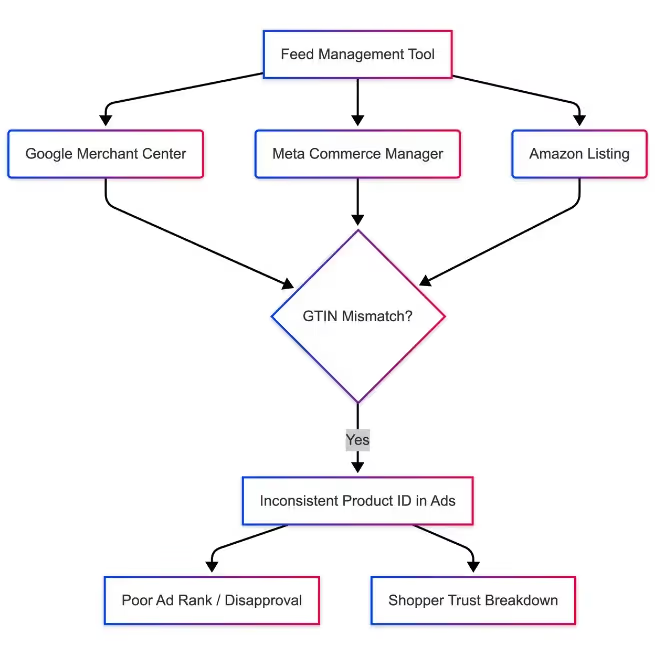
link attribute in your feed—must resolve instantly to the exact, correct variant (color, size, packaging) and price shown in the ad. If the shopper clicks a Performance Max ad only to land on a high-level category page or an out-of-stock variant, the entire trust signal is broken, regardless of your campaign's high Ad Rank or Quality Score.PMax, Advantage+, Shopping, and marketplace ads all rely on clean, coherent product identifiers to understand what you’re selling and when to serve it. When these inconsistencies stack, they don’t just hurt conversion rates—they destabilize every automated decision downstream.
That disconnect feeds that pass diagnostics but still underperform, is one of the most common (and misunderstood) causes of campaign failure.
For years, custom labels have served primarily as a tool for managing margin tiers or high-level inventory categories. This approach is obsolete. The machine learning models driving Performance Max and Meta Advantage+ are sophisticated enough to process signals beyond price; they require the definitive value drivers that justify a conversion.
By turning qualitative value drivers into structured data, you help the algorithms understand which SKUs deserve aggressive bidding and which ones should sit back.
Here are two examples to show how this works in practice:
Example 1: Reliability Signal (Quality + Warranty)
reviews_rating > 4.5 AND warranty CONTAINS "2 Year" THEN set custom_label_4 to "Premium_Trust_Signal". Example 2: Stock Stability Signal (Inventory Confidence)
inventor y > 1000 units AND product_type CONTAINS "Seasonal Essential" THEN set custom_label_5 to "Stable_Inventory_Essential".Once applied at scale, this value taxonomy becomes the connective tissue between your feed and your automated bidding strategies. Instead of throwing the full catalog into PMax and hoping the machine sorts it out, you’re handing it explicit, defensible signals about which products earn priority.
You’re not segmenting your feed by price—you’re segmenting it by why a shopper should trust the product enough to convert.
Value segmentation only works if the underlying data behaves. Without strict, automated rule enforcement, even the smartest custom labels collapse under the weight of inconsistent inputs. PMax, Advantage+, and marketplace algorithms can forgive a lot—but they cannot compensate for a feed that changes shape from channel to channel.
This is why feed rule logic becomes your operational backbone. It’s the only scalable way to guarantee that the value proposition you’ve segmented—reliability, stability, quality—actually shows up consistently everywhere your product appears.
[If you're mapping feeds across multiple channels or enforcing consistent formatting before export, our previous post outlines where and how that enforcement should happen.]
There are three rule classes every merchant needs to operationalize:
These rules protect your ad budget from SKUs that should not enter an automated system.
A. Variant Suppression:
out of stock" OR inventory < 5B. Compliance Cleanup:
This is where most merchants fail: they update one channel and forget the other
A. Price Parity:
B. Promotion Consistency:
sale_price is applied in one feed, the corresponding Promotion ID or equivalent metadata must propagate to every other channel—automaticall This alignment is how you preserve the shopper’s trust signal across discovery, comparison, and checkout.
All logic must run before the channel feeds are generated. This ensures you’re not fixing errors in Google Merchant Center or Meta Commerce Manager—you’re preventing them entirely.
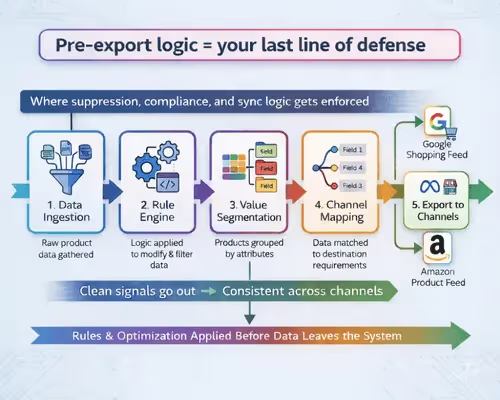
The result is a feed ecosystem that behaves like a single, unified organism: one value taxonomy, one pricing source, one availability truth. This is the level of data discipline required for automated bidding systems to perform beyond average.
[If you're building logic that varies by channel, GoDataFeed's custom feeds overview explains how to set up channel-specific templates that preserve value signals without duplicating feed work.]
In Performance Max and Meta Advantage+, the algorithm’s intelligence is capped by the quality of the signals you give it. If your feed only tells the system a product’s ID, price, and category, you’re asking a machine built for nuance to optimize with three crayons.
Value segmentation changes that. When your feed carries reliable signals—Premium_Trust_Signal, Stable_Inventory_Essential, Low_Awareness_High_Review—the system finally understands why one SKU deserves more aggressive bidding than another. That shift is where ROAS stops plateauing and starts compounding.
Custom labels function as strategic levers inside automated bidding systems:
Build dedicated Asset Groups that only contain your high-value segments, not your whole catalog.
For example:
Premium_Trust_Signal run in an Asset Group with a higher Target ROAS.This alignment lets the algorithm allocate budget based on proven value, not catalog sprawl.
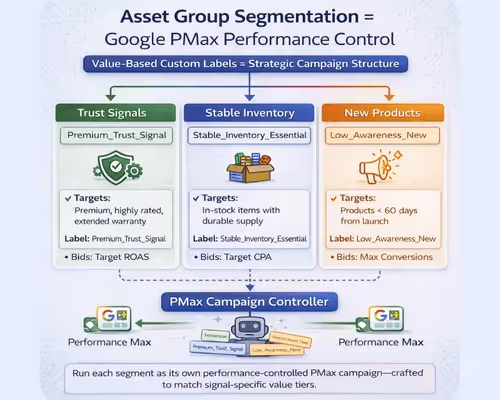
Different value segments carry different levels of risk:
Segmenting by value turns your feed into high-octane data for automated bidding. It moves your catalog from “generic inputs” to algorithmically meaningful signals that directly shift auction outcomes.
If your value proposition doesn’t remain consistent from the moment of discovery to the moment of purchase, the shopper leaves—and the algorithms learn the wrong lessons about your catalog.
The solution isn’t more creative or broader targeting. It’s a feed architecture built to carry the same value signal across every surface the shopper touches.
Any misalignment breaks trust, and trust—not price—is the deciding factor in high-intent moments. Your feed must turn these qualitative drivers into structured signals. Use IFTTT-style feed rules to ensure the same price, availability, and variant persist across Google Merchant Center, Meta Commerce Manager, and marketplaces.
When the source of truth is stable, automated campaigns become predictable and profitable. When it’s not, even perfect segmentation fails.
Bryan is a digital marketer with roots in journalism and creative writing. Over the past decade, he's helped hundreds of online retailers develop and implement ecommerce marketing strategies. When he isn't educating retailers on ecommerce, he's out exploring South Florida and stalking local breweries.
Run a free feed audit and see which of your titles are matching queries you'd never choose to bid on.