




















































Now that you understand Google's Universal Commerce Protocol, the real work begins: getting your store to speak it. The transition to agentic commerce doesn't require a total re-platforming, but it does demand a rigorous audit of how your data flows to the outside world.
For UCP implementations on Google surfaces, your Merchant Center product feed is no longer just a list of ads—it is the eligibility and semantics layer of the protocol.
In the agentic economy, your feed isn't just a digital catalog; it is the source code for the transaction. If your feed is thin or inconsistent, your products are effectively invisible to the protocol.

To be UCP-ready, your product feed must:
Keep your base attributes (ID, Price, GTIN, MPN, Availability) pristine.
Think of these base attributes as your passport data. If your GTIN is wrong or your Price is ambiguous, the Agent cannot verify your product's identity against the global catalog. Without visual browsing, data accuracy is the only way to prove your product exists.
Humans might forgive a typo or a vague title, but a protocol will not. Inaccurate base data creates “identity friction,” causing the agent to flag your catalog as unreliable and bypass your store entirely.
native_commerce AttributeThis is the "On Switch."
While native_commerce functions as your primary “On Switch” (Boolean), it effectively acts as a gatekeeper. If set to False (or missing), the SKU is treated as “Display Only”, essentially making it visible to the search index but strictly locked out of the transactional protocol.
If this is missing or set to false, the AI might see your product, but it cannot buy it.
This prevents the “zombie order” problem where an AI tries to buy a product you haven't authorized for programmatic sale. It acts as your safety mechanism, ensuring that only inventory you have explicitly cleared for programmatic sale is accessible, preventing AI from clearing out stock reserved for other channels.
AI-mode queries are conversational ("Find me a boot for hiking in muddy terrain").
If your feed lacks attributes like materials, use-cases, and dimensions, the AI cannot confidently match your product to the user's intent.
Product discovery now hinges on compatibility. When you populate “Material” or “Dimensions,” you’re not just filling fields, you are arming the Agent with the answers it needs to surface your product over competitors.
If you don't provide the specs, the Agent defaults to the product that does.
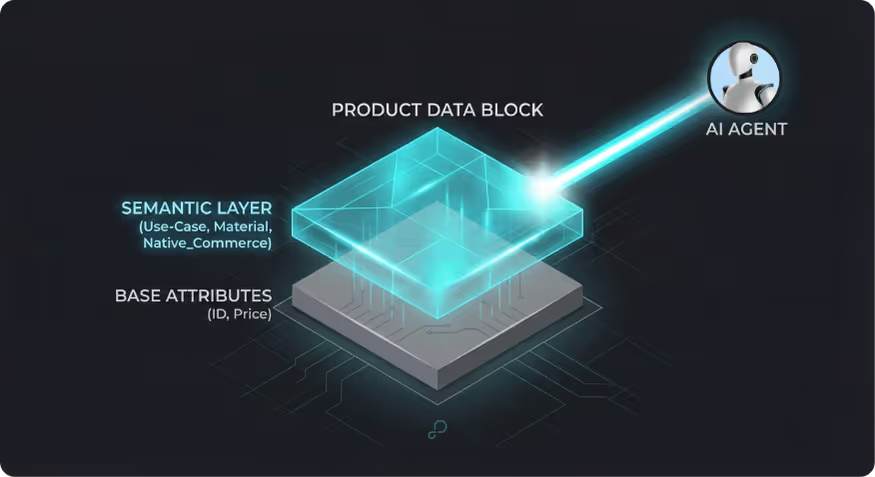
From a static inventory list to a dynamic eligibility engine, the role of the product feed is changing. In this automated environment, data gaps like inconsistent attributes or missing definitions don't just lower click-through rates, they cause the purchasing agent to abandon the transaction entirely.
UCP forces us to treat boring backend operations as first-class marketing assets.
Agents require “total cost” certainty before they act. This means your operational data like shipping and tax configured in your Merchant Center settings are now just as critical as your product price. If the agent can't calculate the final bill instantly, it won't initiate the checkout.
You must expose your operational logic so the AI can close the sale for you. Here is what needs to be exposed to the protocol:
An AI agent needs to calculate the "Landed Cost" (Price + Tax + Ship) instantly to compare options for the user.
UCP retrieves your shipping and tax tables from Merchant Center to instantly compute the Landed Cost for the user's specific location, without needing to ping your checkout page for a quote. If your shipping tables are outdated or your return policy is vague, the agent will deprioritize your product because it can't guarantee the final price.
Agents cannot "browse" your website; they need a structured door to enter and transact.
Merchants must expose standard endpoints (REST or gRPC) for the three-stage handshake: Session, Update, and Completion. This allows the agent to build a cart, apply a promo code, and finalize the order programmatically without brittle web scraping or session hijacking.
Once an order is placed, the AI agent needs to know what happened so it can update the user ("Your package has shipped").
Merchants are expected to push order updates back to the protocol so that post-purchase flows (tracking, cancellations) remain machine-readable.
Frictionless buying requires knowing who is buying and how they are paying.
UCP supports guest checkout by default to lower friction but leverages OAuth 2.0 for account linking, allowing for loyalty integration.
For payments, it uses the Agent Payments Protocol (AP2) to declare which wallets and handlers are supported, ensuring the agent routes the transaction correctly.

Because UCP changes how stores connect to shoppers, it raises immediate technical questions regarding stack compatibility and data ownership. These are the most frequently asked questions we’re seeing:
Q: Do I need to rebuild my entire commerce stack to use UCP?
A: No. UCP sits on top of your existing platform. You need a clean Merchant Center account, a UCP-aware feed, and a small set of REST endpoints for checkout.
Q: Is this just "Buy on Google" rebranded?
A: No. Previous initiatives like “Buy on Google” were walled gardens. UCP is a universal bridge that allows your store to accept orders from any authorized AI agent, whether it's on Google Search, a smart speaker, or a third-party assistant.
Q: What’s the minimum I must change in my product feed?
A: Ensure all required attributes are populated for pricing, availability, and compliance, and add the native_commerce attribute for SKUs you want eligible for UCP checkout.
Q: How does UCP affect my attribution and customer data?
A: You remain the Merchant of Record, meaning you handle the tax, liability, and fulfillment exactly as if the order came through your own checkout. UCP simply standardizes the “Add to Cart” signal.
Q: Can non‑Google agents use UCP to buy from my catalog?
A: Yes in principle; the protocol is designed to be open and vendor‑agnostic, so any AI or agent platform that implements UCP can interface with your endpoints.
Q: What is the fastest path to experimentation? A: Start with your data. Harden your product feed, populate the native_commerce attribute, and ensure your Merchant Center shipping/tax settings are bulletproof. Once the data layer is ready, you can look at implementing the checkout endpoints.
The shift to agentic commerce is inevitable, but readiness is optional. You can wait for the protocol to become standard, or you can prepare your infrastructure now to capture the first wave of autonomous demand.
Book a free feed audit and strategy session to ensure your store is ready for agentic commerce
Bryan is a digital marketer with roots in journalism and creative writing. Over the past decade, he's helped hundreds of online retailers develop and implement ecommerce marketing strategies. When he isn't educating retailers on ecommerce, he's out exploring South Florida and stalking local breweries.
Run a free feed audit and see which of your titles are matching queries you'd never choose to bid on.