




















































While your competitors are still trying to claw back "zero-click" traffic, the most sophisticated retailers are moving their storefront into the prompt.
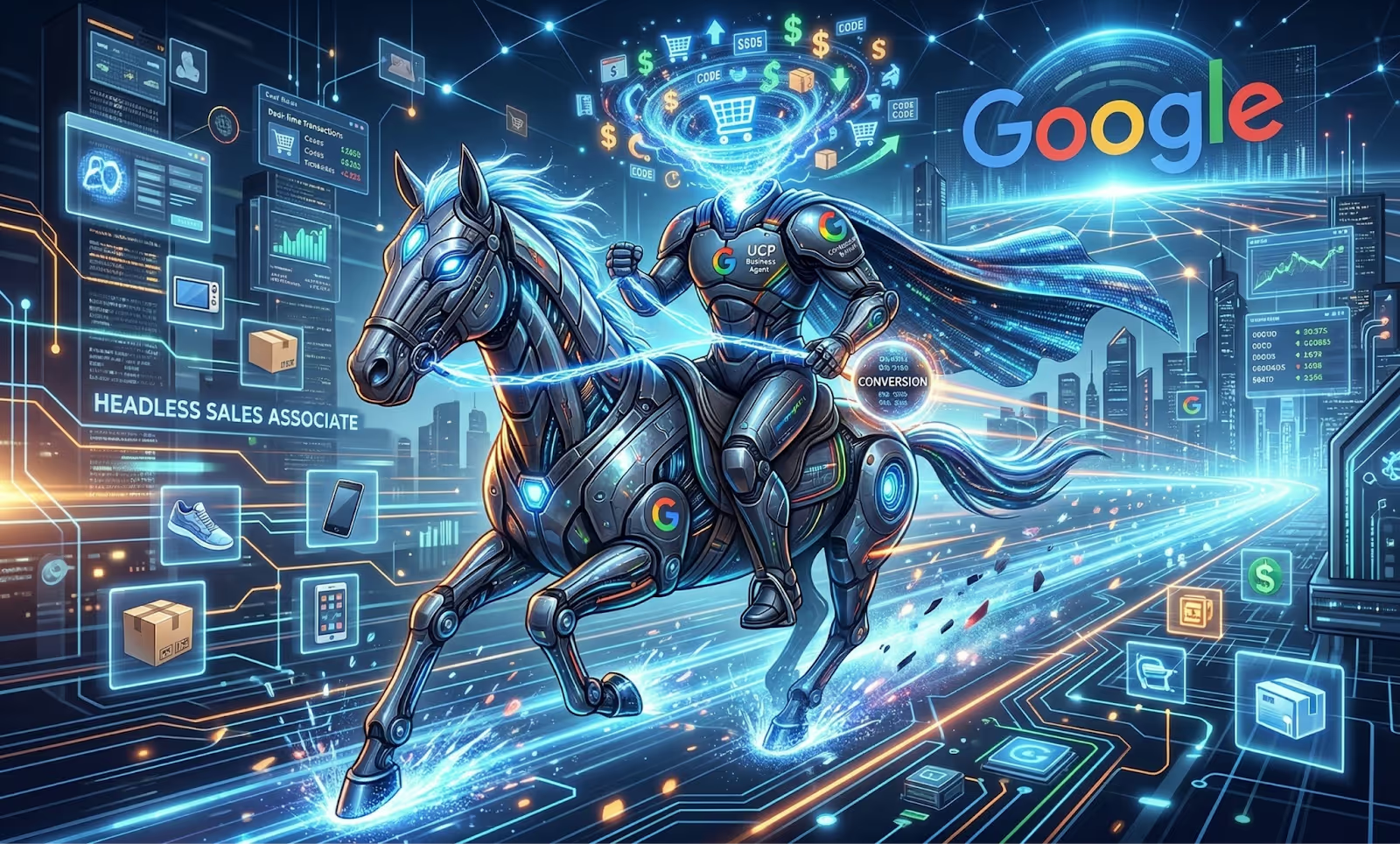
The Google Business Agent isn't just a chatbot. It’s a headless sales associate. A brand-conscious representative that lives inside Gemini and Search to answer technical questions, compare your specs against competitors, and execute checkouts without a single user ever visiting your website.
The goal of ecommerce SEO used to be simple. Clicks.
In 2026, the goal is to drive a handshake. Traditional storefronts are being skipped over by AI-powered search results. To stay relevant in this new environment, your product data must do more than just show up in an index—it must be detailed enough to handle the entire sale.
By treating the Business Agent as your brand’s "On Switch" for agentic commerce, Google UCP effectively turns Gemini into a sales channel. This means your backend data—the technical specs, shipping tables, and inventory—now does the heavy lifting that your website's UI used to handle.
The Business Agent operates on a Retrieval-Augmented Generation (RAG) architecture.
It doesn't guess what you sell; it pulls specific chunks of data from the Google Shopping Graph to answer shopper questions in real-time.
If a user asks, "Is this rug durable enough for a high-traffic mudroom?" the agent isn't looking for keywords—it’s looking for the specific durability and material attributes in your feed that prove the product fits the use-case.
In this environment where AI autonomously retrieves product data, the Business Agent uses your Merchant Center feed as its primary source of facts to ground every conversational response.
In agentic shopping, semantic coverage refers to the depth, breadth, and accuracy with which an AI system understands the meaning, relationships, and business context of product data, rather than the syntax. It measures how well a system captures the real-world meaning of data.
The Agent relies on functional context to bridge the gap between what a user says and what a product actually does.

In agentic, your data attributes serve as the logical proof required to satisfy the Agent’s search criteria. Attributes like material grade, temperature ratings, and technical compatibility are the only some of the "arguments" the Business Agent can use to recommend your SKU over a competitor's.
If your product data is thin or inconsistent, the Business Agent cannot confidently represent your brand. It will skip your product on its way to present someone else’s to the shopper.
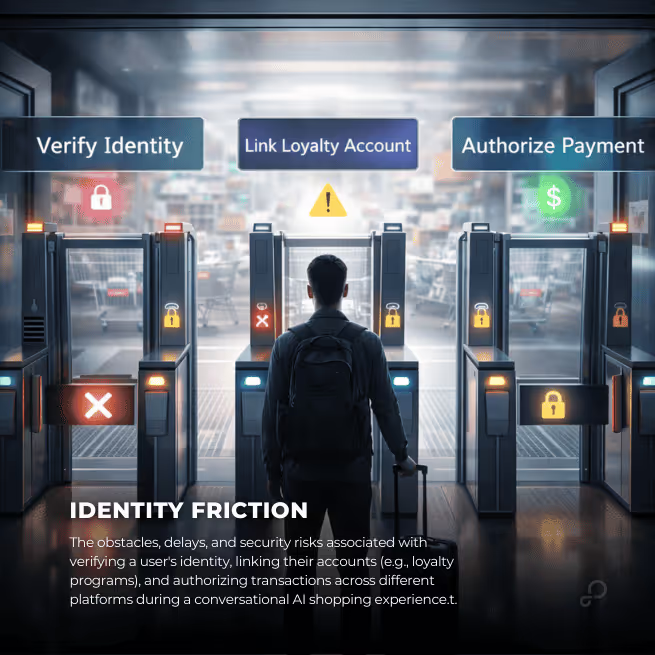
Missing GTINs, vague product titles, or outdated shipping tables create identity friction.
When the agent hits these data gaps, it won't guess—it will simply flag your catalog as unreliable and bypass your store in favor of a brand with cleaner, more complete technical data.
The native_commerce attribute is the gatekeeper for on-platform transactions, moving your catalog from "Display Only" to "Eligible for Checkout."
The transition from a passive discovery agent to an active sales representative requires an explicit authorization signal.
Implementing the Boolean native_commerce attribute in your Merchant Center feed tells Gemini that a product is authorized for programmatic sale.
If this attribute is set to false or left missing, the SKU remains in "Display Only" mode; the Agent can show the product to a user but is strictly locked out of the transactional protocol.
The native_commerce attribute serves as a critical safety mechanism for your inventory management.
By controlling the native_commerce signal at the SKU level, you prevent the "zombie order" problem where an AI agent attempts to purchase a product you haven't authorized for programmatic channels.
This ensures that only inventory you have specifically cleared for agentic is accessible, preventing the protocol from clearing out stock reserved for other high-priority channels.
The native_commerce toggle for Google UCP is typically found within the product feed settings of your Google Merchant Center.
If not directly available in GMC settings, the native_commerce parameter may be managed using feed rules. For some Shopify users, it will be found within the Google & YouTube app settings.
Once the native_commerce "on switch" is flipped, the UCP Business Agent moves from conversation to commerce by activating the 3-stage handshake.
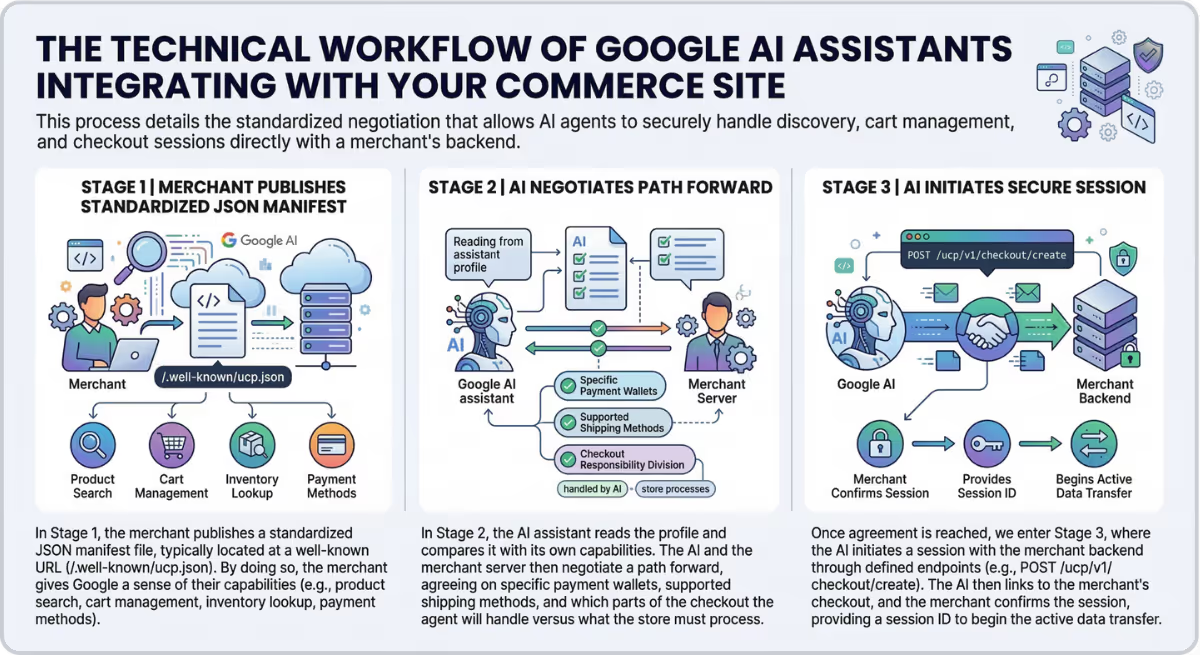
Google UCP 3-Stage Handshake (Download)
Instead of scraping your website’s UI, which agents cannot "browse" in the traditional sense, the protocol uses standard REST or gRPC endpoints to enter your store.
These endpoints allow the agent to manage a Session, Update the cart with promo codes or shipping preferences, and finalize the Completion of the order programmatically.
To finalize the sale, the Business Agent requires "Total Cost" certainty, making your shipping and tax tables high-signal marketing assets. Here’s how it works.
The Business Agent can't "guess" the final price; it needs to calculate the Landed Cost (Price + Tax + Shipping) instantly to compare your offer against competitors for the user.
The Universal Commerce Protocol retrieves your shipping and tax tables directly from your Merchant Center configurations to compute this total without needing to ping your checkout page for a manual quote. If these tables are outdated or your return policy is vague, the Business Agent will deprioritize your product because it cannot provide the consumer with a guaranteed final price.
Once an order is successfully placed, the representative's job isn't finished; it must keep the shopper informed to maintain the brand relationship.
Merchants are expected to push order updates—such as tracking numbers, delays, or cancellations—back to the protocol via webhooks. This allows the Business Agent to handle post-purchase support conversations directly within Gemini, ensuring the flow remains machine-navigable and contextually relevant to the user's initial query.
Frictionless commerce requires the agent to know exactly who is buying and how they are paying before the handshake is completed.
UCP standardizes this through the Agent Payments Protocol (AP2), which declares which digital wallets and payment handlers your store supports.
While the protocol supports guest checkout to lower entry friction, it also leverages OAuth 2.0 for account linking. This ensures your Business Agent can apply existing loyalty points or member-only discounts during the transaction, keeping your CRM and loyalty logic intact.
The introduction of the Business Agent confirms Google as a transactional platform for autonomous software. That makes the adoption of a "product API" mindset even more important because it ensures your store remains the primary authority for its own data.
Agentic commerce is an evolutionary jump in how your product data communicates with the world. Getting the connection wrong could mean getting ignored by AI commerce protocols like UCP.
But you don't have to engineer this transition alone.
Let’s look under the hood together. Book a free consultation to review your data strategy, identify your semantic gaps, and ensure your store is ready for Google UCP’s Business Agent.
Bryan is a digital marketer with roots in journalism and creative writing. Over the past decade, he's helped hundreds of online retailers develop and implement ecommerce marketing strategies. When he isn't educating retailers on ecommerce, he's out exploring South Florida and stalking local breweries.
Run a free feed audit and see which of your titles are matching queries you'd never choose to bid on.