





















































For the past decade, ecommerce marketing innovation focused on removing friction for human thumbs. We optimized checkout flows, sped up mobile sites, and A/B tested button colors. The next phase of commerce, however, requires a new architecture that removes friction for autonomous software (not just humans) to transact.
This is the specific engineering problem the Universal Commerce Protocol (UCP) attempts to solve.
UCP is not a new marketplace, and it isn't just another Google Shopping Ads campaign format.
It is the infrastructure for AI-native shopping—an open, neutral standard that allows AI agents to discover products, negotiate capabilities, and place orders without a human ever visiting your website.
UCP provides the necessary standardization to make these automated transactions scalable.
To understand UCP, you have to look at the mess of current integrations. Right now, if a new social app, AI assistant, or smart device wants to sell your products, it requires a custom integration.
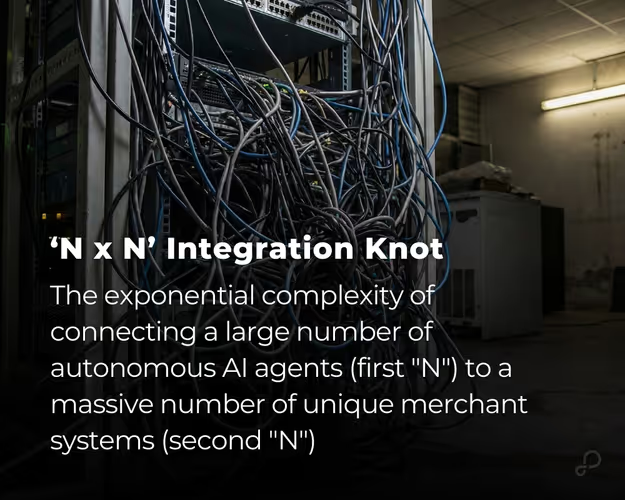
We call this the "N × N" Integration Knot. When retailers need custom integrations to marketplaces and AI needs custom integrations with retailers. It is unstable and unscalable.
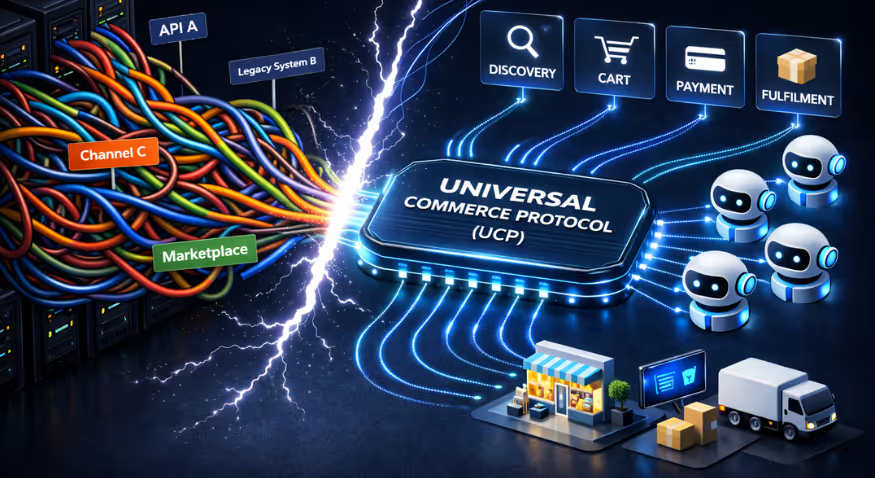
UCP cuts the knot. Instead of building custom integrations for every new AI tool, UCP defines a standard set of capabilities—discovery, cart, payment, and fulfillment—that any agentic interface can plug into.
Think of UCP like the "USB port" for commerce. Before the USB, connecting things to computers was not fun. We needed one cable for the monitor, another for the mouse, a third for the keyboard, and that doesn’t even cover the printer.
Now, thanks to the mighty USB, things just “plug in.”
UCP aims to do the same for shopping: Allow any AI agent to plug into any retailer and immediately understand how to interact with it in order to browse, buy, and track orders.
UCP is designed to run on any surface—not just Google Gemini or Search. It relies on a few non-negotiable principles:
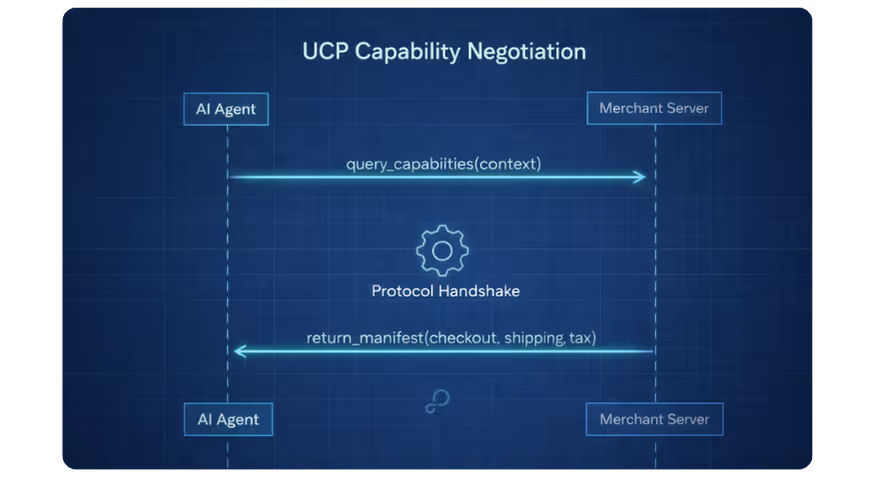
Before a transaction starts, the AI agent and the Merchant "handshake."
The agent asks, "Can you do guest checkout? Do you ship to zip code 90210? Do you accept Apple Pay?"
The merchant system responds with its capabilities.
This is critical for brands. Unlike a marketplace where you lose the customer data, under UCP, the retailer remains the Merchant of Record.
You keep the customer relationship, the data, and you use your existing tax and security/fraud-detection stacks.
It uses familiar tech (REST, JSON-RPC) to integrate and cooperate with other emerging standards like the Agent Payments Protocol (AP2) and Model Context Protocol (MCP).
There seems to be a lot of confusion around what the Universal Commerce Protocol actually is, and Google’s track record is a big reason why.
Over the years, we’ve watched a parade of Google ecommerce experiments come and go: Froogle, PLA, Google Checkout, Google Express, Buy on Google.
But that might also be the reason UCP succeeds this time.
From all those flops, Google seems to have finally learned an important lesson: Stop chasing Amazon. Google is a search engine, not a retailer. And those attempts at owning the checkout (Amazon-style) hurt its core ad revenue model.
Unlike Google Checkout, Buy on Google, and Google Express, UCP is not a marketplace. It is an open infrastructure standard that different systems agree to follow so they can transact cleanly together.
In practice, it shows up as a set of standardized APIs and message formats that let an AI agent say “create a cart,” “update this order,” or “charge this card” in the same way for every participating retailer.
Under the hood, engineers implement UCP by wiring these API definitions into their existing commerce stack—catalog, checkout, payments, fulfillment—so that those capabilities become callable by agents.
To everyone else, UCP is the invisible wiring that turns a messy web of custom integrations into a consistent, reusable way to do shopping, payment, and delivery across many surfaces.
Commerce is evolving from a user-centric search model to an agent-centric negotiation model. UCP provides the standardized framework for these automated interactions.
You can’t control how AI ranks products next year, but you can control whether your catalog is technically compatible with these new protocols.
Is your product feed ready for the Agentic Economy?
Don't guess. Contact us to get a forensic analysis of your current feed capabilities and a roadmap for protocol readiness.
Bryan is a digital marketer with roots in journalism and creative writing. Over the past decade, he's helped hundreds of online retailers develop and implement ecommerce marketing strategies. When he isn't educating retailers on ecommerce, he's out exploring South Florida and stalking local breweries.
Run a free feed audit and see which of your titles are matching queries you'd never choose to bid on.

.avif)