




















































A new distribution engine has quietly grown to marketplace scale while most DTC teams still file it under “social.”
In Q3 2025, TikTok Shop generated an estimated $19 billion in global GMV, essentially matching eBay’s $20.1 billion for the same period. Between $4 billion and $4.5 billion of that came from the U.S. alone, up roughly 125% quarter over quarter.
That is not “experimental channel” territory. That is parallel marketplace scale.
For DTC brands, that parity is the tell. Social commerce is no longer “social media plus links.” It is a high-velocity distribution engine, with its own economics, behaviors, and infrastructure needs. Treat it like a campaign and you’ll get campaign results.
Treat it like a channel on par with marketplaces and retail, and it starts to look like a core growth lever.

TikTok Shop’s rise happened fast. In 2024, annual GMV was about $33.2 billion; by the first half of 2025, it had already cleared $26 billion, with U.S. shoppers contributing a rising share. eBay, by contrast, took decades to build to a $20.1 billion quarter.
This velocity matters. It means your customer now expects to discover, evaluate, and buy in the same swipe that surfaces the product. The “click out to a PDP and wander around” era is fading inside social environments. The unit of competition is the micro-moment.
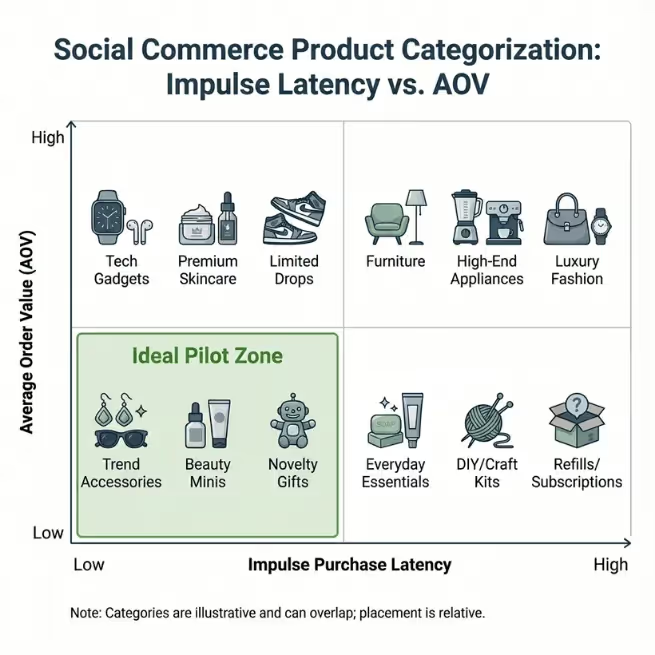
The starting point is SKU strategy. Not every product belongs in a 9-second video. You’re looking for items with impulse purchase latency under 30 seconds: low-friction price points, obvious benefits on camera, and tight use cases. Think accessories, beauty, small home goods, consumables with clear before/after proof.
Instead of dragging your full catalog into TikTok Shop, pilot those high-velocity SKUs first. Use them as probes: Which categories clear carts fastest? Which creators and hooks convert cold audiences?
Treat this as live market research that also drives revenue.
From there, build the creator-led conversion loop. On TikTok Shop, the path is simple: content → instant cart → checkout. The “ad” is often a piece of UGC or creator content that looks like everything else in the feed, just with a more deliberate hook and a shoppable overlay. Your job is to make sure nothing breaks after the tap.
That requires operational alignment. Pricing, inventory, and availability must sync in real time between your core commerce stack and TikTok’s APIs. If a creator pushes a product that just went out of stock or changed price, you don’t just frustrate buyers—you risk policy issues and reduced distribution. The rule: if it’s not sync-safe, it’s not ready for social commerce.
[Learn how to integrate and sync TikTok Shop feeds with GoDataFeed: https://help.godatafeed.com/hc/en-us/articles/17111953935259-Feed-TikTok-TikTok-Shop-Feed-TikTok-Order-Sync]
A social commerce distribution engine needs different plumbing than a traditional DTC stack.
On the product side, you need catalog ingestion and normalization that can take your master product feed and instantly reshape it for TikTok Shop: shortened titles, thumb-stopping imagery, variant mapping, and compliance with channel-specific requirements. That feed has to stay in lockstep with your inventory and order systems via platform APIs so you’re never selling ghosts.
On the creative side, your tools need to support rapid versioning. You’re testing 3-second hooks, not seasonal taglines. That means workflows for generating, tagging, and measuring dozens of short clips per SKU, plus handling metadata (sounds, captions, product tags) that feeds social ranking and discovery.
.avif)
Then there’s live commerce. In the U.S., live shopping is still a small slice of TikTok traffic compared to short-form video, but globally it’s a proven format. Your infrastructure should already support “live-to-cart” flows: clipping and replaying live segments, keeping stock levels accurate in the moment, and routing orders without manual intervention. You don’t need to bet the brand on live yet—but you do need the rails in place.
The lesson from TikTok and Meta is clear: in 2026, DTC success will hinge on how well you control product data and act across every high-velocity, impulse-driven channel—not how clever your next campaign sounds.
The non-negotiables are straightforward:
The practical question for every brand: if TikTok Shop can add roughly $4 billion in U.S. sales in a single quarter, can your infrastructure cope with even a fraction of that step-change in demand?
Start with a readiness audit—feeds, inventory, checkout, returns—and a small, focused pilot. The creative will evolve. The infrastructure you build now is what will decide whether you’re just present on social commerce, or actually competing in it.
Bryan is a digital marketer with roots in journalism and creative writing. Over the past decade, he's helped hundreds of online retailers develop and implement ecommerce marketing strategies. When he isn't educating retailers on ecommerce, he's out exploring South Florida and stalking local breweries.
Run a free feed audit and see which of your titles are matching queries you'd never choose to bid on.