




















































When enough advertisers adopted Smart Bidding, the Google Shopping auction changed character.
Manual CPC campaigns impose a human ceiling on what any individual advertiser will pay. Smart Bidding removes it. The system bids based on predicted conversion probability. When every major advertiser in a category runs the same optimization strategy, the auction floor for high-intent queries rises in step.
We watched CPCs in competitive categories climb—not because search demand increased proportionally, but because the supply of human bid constraints evaporated. According to Tinuiti’s Digital Ads Benchmark reports, Google paid search CPCs continue to see consistent year-over-year growth, with average CPCs rising 5% in early 2025 and branded text search CPCs surging by 19%. As algorithmic bidding pursues the same high-intent cohorts, the floor price for conversion-ready traffic simply resets at a higher baseline.
That is the macroeconomic reality. To understand the response, we have to look at the channel mechanics.

The rollout of iOS 14.5 fundamentally broke deterministic attribution—the ability to draw a direct, verified line from a specific ad click to a specific website purchase—across Meta's inventory.
Most Meta click traffic runs through in-app browsers, which no longer reliably pass cookies back to the advertiser's domain. When deterministic tracking fails, ad platforms rely on algorithmic modeling to fill the gaps. Platform-reported ROAS often held up through the transition, but Shopify revenue, reconciled against it, did not agree.
Brands running strict reconciliation found platform attribution overstating actual conversions by 20 to 40 percent. This discrepancy is widely documented by third-party attribution platforms. Post-ATT ecosystem data from tracking engines like Triple Whale and Northbeam consistently showed that Meta's modeled, in-platform ROAS frequently overstated deterministic, first-party revenue—especially in retargeting flows—by an average of 15% to 40%.
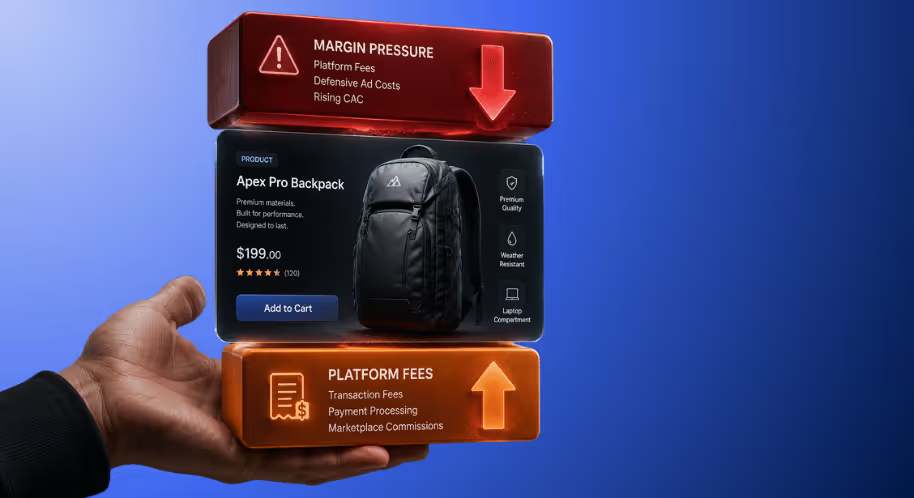
Amazon and Walmart Sponsored Products operate on a strict pay-to-play architecture: bid for position, and the winning bid surfaces at the top.
As third-party seller counts expanded, brand manufacturers began running paid placements defensively—paying to protect the organic share they historically held for free. According to Wordstream's 2026 industry benchmarks, the average CPC for e-commerce and retail search ads has reached $1.30. This defensive posture pushes the Advertising Cost of Sales (ACoS) into the 20% to 30% range for highly competitive sectors.
For brands in commodity-adjacent categories, the cost to hold top-of-search positions has compressed margins to break-even territory on ad spend alone, even before calculating platform fees and fulfillment costs.

With the forced migration from Standard Shopping to Performance Max (PMax), Google effectively removed keyword-level bidding controls from the advertiser's toolkit.
To access high-intent Shopping placements, brands are required to buy into a "black box" of blended inventory. As documented by Search Engine Land, the historical limitations on negative keywords in PMax restricted advertisers' control over where their ads appeared. While PMax drives significant volume, this lack of targeted exclusion has caused blended Customer Acquisition Costs (CAC) to rise, as advertisers effectively subsidize lower-converting placements across the Display Network and YouTube.
Affiliate marketing runs on a different cost sequence.
Commission in an affiliate program is a Cost of Goods Sold (COGS) that appears only after revenue is captured. There is no click budget, no impression minimum, and no platform auction competing against other advertisers' automation.
The spend event strictly follows the conversion event. In a margin-compressed environment, that sequence is a structural financial advantage. Affiliate marketing was always available, but during the years when Shopping ROAS was reliable and CPCs were low, most brands rationally deprioritized it. That math has inverted.
Bryan is a digital marketer with roots in journalism and creative writing. Over the past decade, he's helped hundreds of online retailers develop and implement ecommerce marketing strategies. When he isn't educating retailers on ecommerce, he's out exploring South Florida and stalking local breweries.
Run a free feed audit and see which of your titles are matching queries you'd never choose to bid on.