



















































Most multichannel strategies don’t fail because teams choose the wrong channels.
They fail because the same product behaves differently everywhere it appears.
Add another channel without fixing feed structure, and you scale inconsistency.
If Google Shopping, Meta catalog ads, TikTok Shop, and marketplace listings aren’t reinforcing each other, the issue usually isn’t bids.
It’s attribute drift.
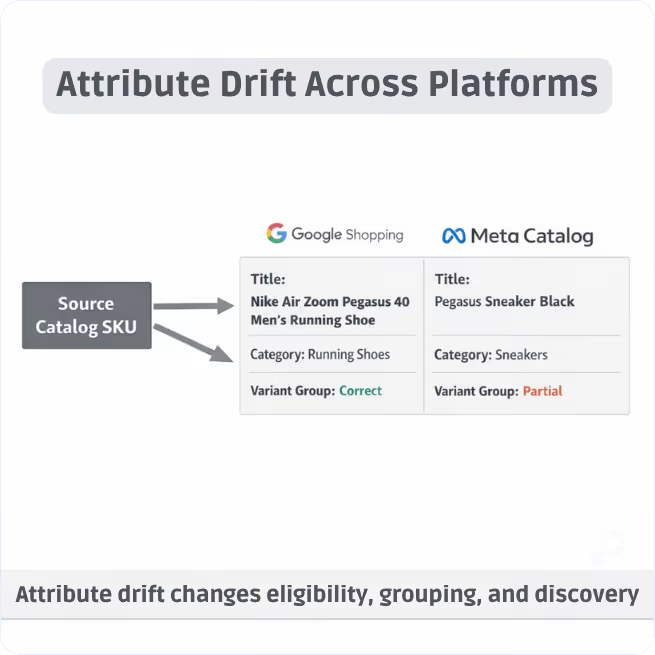
Fixing this starts with governance, not expansion. Teams that prioritize structured product feed optimization workflows usually stabilize performance before touching budgets.
Here’s what actually breaks.
The same SKU shows up with:
Each platform interprets that product differently.
That affects:
If a product scales on one channel but stalls on another, attribute inconsistency is often the cause.
The fix is attribute authority.
Decide once:
Then enforce those decisions upstream.
Example:
Google title template{brand} + {product_type} + {material} + {size}
Meta title template{lifestyle modifier} + {category} + {color}
Same SKU.
Different intent.
Controlled deliberately.
This kind of channel-specific feed rule logic is what prevents platforms from learning conflicting versions of the same product.
Most teams still treat titles like storefront text.
Platforms treat them like classification signals, which is why optimized Google Shopping title structures consistently outperform merchandising-style naming conventions.
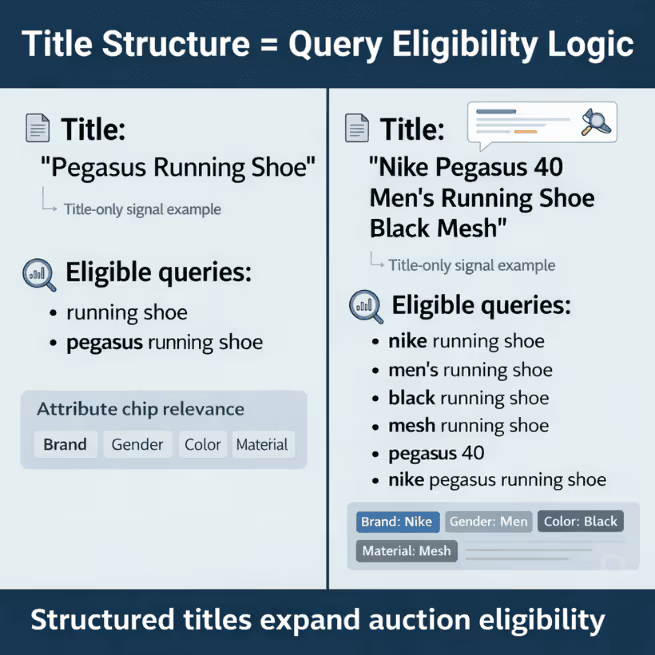
Google uses titles to match products to relevant queries.
Meta uses them to assemble dynamic creative from catalog data.
Marketplaces use them to improve match confidence and browse placement.
When titles lose attributes, platforms lose context.
Example from a footwear catalog:
Titles were shortened to improve display formatting in Shopping placements.
But gender modifiers, activity qualifiers, and material attributes disappeared.
Non-brand visibility dropped.
After restoring structured attributes through title rules, visibility improved without bid changes.
Titles don’t just affect click-through rate.
They affect which queries a product can enter.
When titles drift across exports, platforms learn different things about the same SKU.
That weakens performance everywhere.
Variants often look correct in Shopify.
Then split inside ad catalogs.
This usually happens when variant attributes are inconsistent.
Common causes:
blk, black, and jet used interchangeablyitem_group_id, especially when variant grouping rules across marketplaces aren’t enforced upstream.Both Google and Meta rely on consistent variant grouping to understand relationships between products.
When grouping breaks:
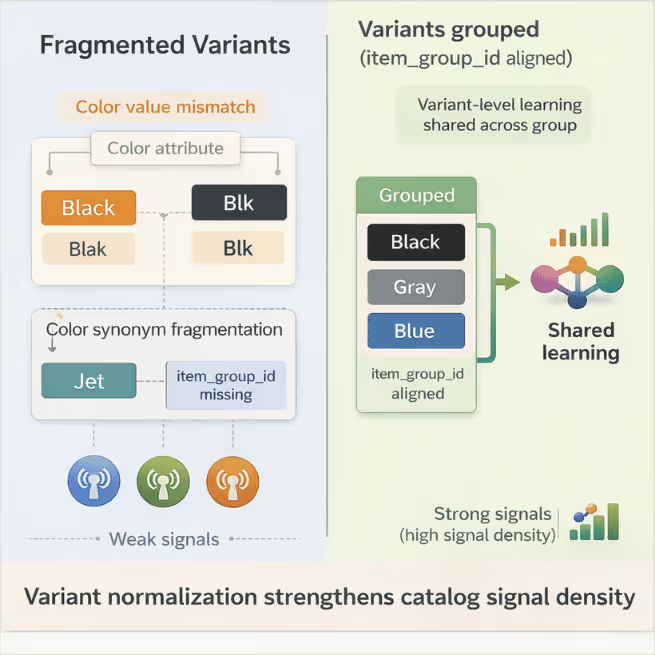
Fix this at the export layer.
Example rule logic:
If color contains blk
→ normalize to Black
If size contains US
→ extract numeric value
Then enforce:
item_group_id = parent_sku
Now, variants reinforce each other instead of competing.
This becomes even more powerful when combined with group-level variant availability controls that suppress incomplete variant sets before they enter acquisition campaigns.
A product can be approved and still underperform.
Incorrect taxonomy often causes this.
Example:
Actual category
Running Shoes
Mapped category
Athletic Shoes
Still valid.
Still approved.
But classification confidence drops.
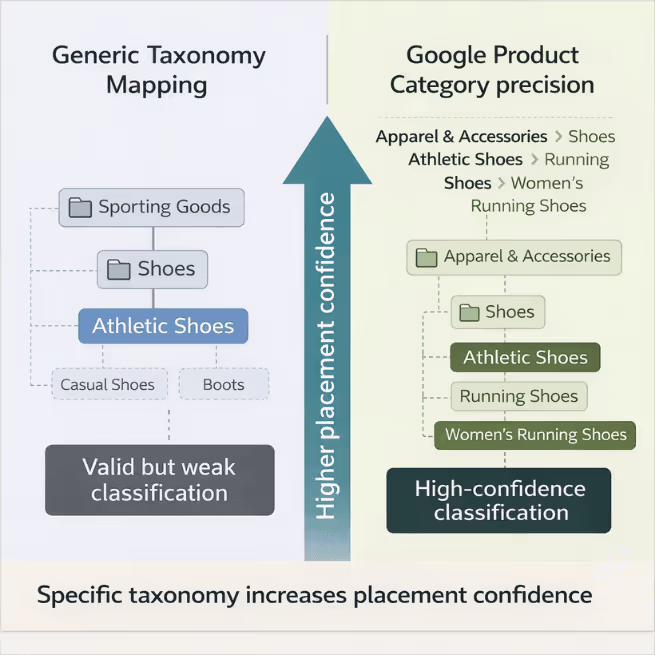
Google uses taxonomy and related attributes to determine whether products are eligible for specific queries and surfaces.
Meta uses category signals to describe catalog inventory and support delivery logic.
Amazon relies on browse nodes to determine discovery depth.
Generic mapping reduces visibility without triggering errors, which is why category mapping and taxonomy alignment workflows belong upstream in the export layer instead of inside campaign segmentation.
Fix this with conditional overrides.
Example:
If product_type contains running
→ map to Running Shoes
If gender = female
→ map to Women’s Running Shoes
Campaign settings stay the same.
Classification improves anyway.
Most teams treat custom labels as reporting fields.
They are segmentation controls inside Google Merchant Center.

Google supports five custom labels.
Example structure:
custom_label_0 = margin tier
custom_label_1 = inventory pressure
custom_label_2 = seasonal status
custom_label_3 = hero products
custom_label_4 = clearance candidates
Example usage:
High-margin SKUs
→ priority asset groups
Low-inventory SKUs
→ remarketing-only campaigns
Clearance SKUs
→ aggressive visibility strategy
This defines exposure at the SKU level.
Apply the same segmentation logic across Meta, TikTok Shop, and marketplaces using their own catalog filters.
Now strategy stays consistent even when optimization systems differ.
Most feeds treat inventory as binary.
In stock or out of stock.
That removes control.
Inventory depth should influence whether a SKU enters prospecting campaigns at all.
Example framework:
Inventory < 5
→ exclude from acquisition campaigns
Inventory 5–20
→ remarketing only
Inventory > 20
→ eligible for prospecting
Exact thresholds depend on margin and replenishment speed.
But the principle holds.
If inventory = 0
→ exclude to prevent wasted sessions on unavailable stock
Feed logic should control exposure before campaigns do, which is exactly what inventory-based feed filtering rules are designed to enforce at export time.
This stabilizes performance without adjusting bids.
Many teams update marketplace pricing faster than advertising feeds.
Platforms compare feed prices with landing-page prices.
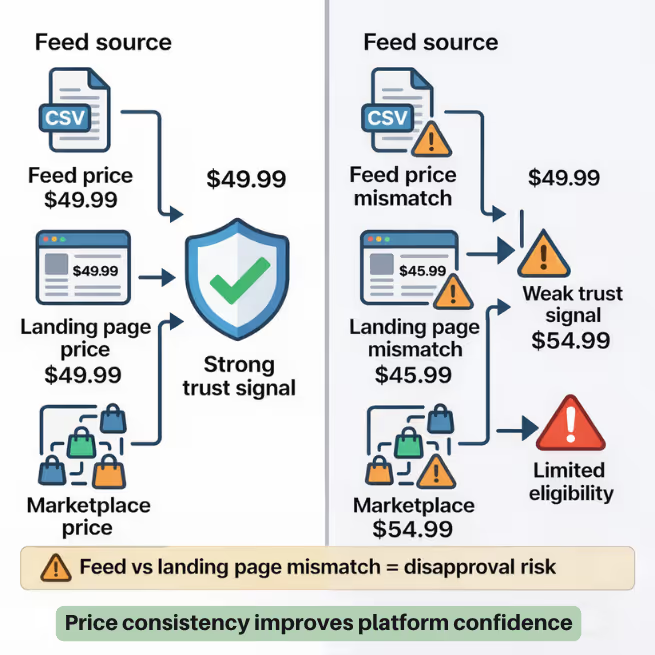
They also model competitiveness relative to other listings.
Google Merchant Center can flag price mismatches directly.
But cross-channel inconsistency can still affect performance even without disapprovals.
Fix this at the export layer.
Example logic:
If promotion active
→ update sale_price where the landing page reflects the same promotion
If marketplace price differs
→ review competitiveness strategy instead of forcing feed overrides
Feeds must match the destination page.
Always.
Price alignment builds trust signals across channels.
Treating TikTok Shop as a US-only experiment leads teams to under-prioritize feed governance there.
It already operates as a global commerce engine at marketplace-level GMV scale.
That changes how the catalog structure should be handled, especially when channel-specific feed optimization rules control how attributes adapt per surface.
Attribute consistency between TikTok Shop, Google Merchant Center, Meta Commerce Manager, and marketplaces determines whether discovery systems reinforce each other or fragment.
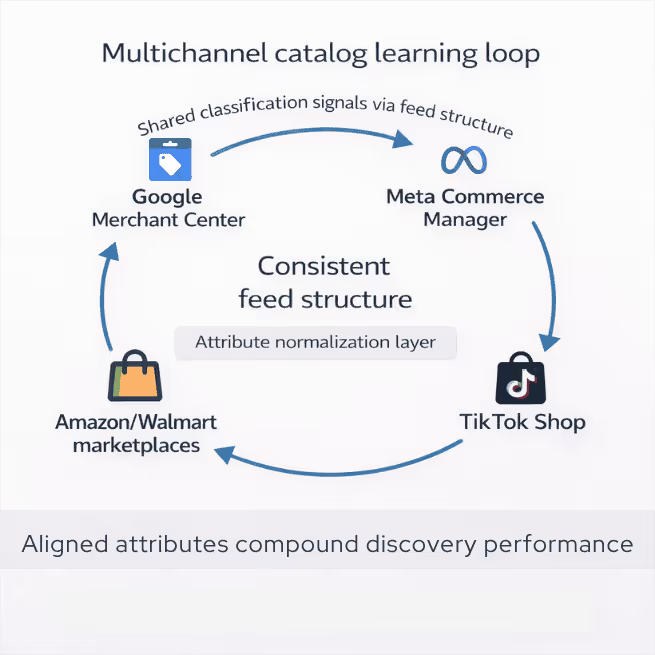
If titles, variants, taxonomy, and pricing drift between exports, each platform learns a different version of the same SKU.
And optimization systems stop compounding signal.
They’re catalog structure problems.
When the same SKU behaves differently across platforms, optimization systems don’t reinforce each other.
They compete.
That shows up as:
Most teams respond by adjusting bids.
Or restructuring campaigns.
Or adding budget.
But none of those fix attribute drift.
Feed governance does.

Before changing anything inside Google Ads or Meta, run a simple check.
Pick one SKU.
Compare it across:
Look at:
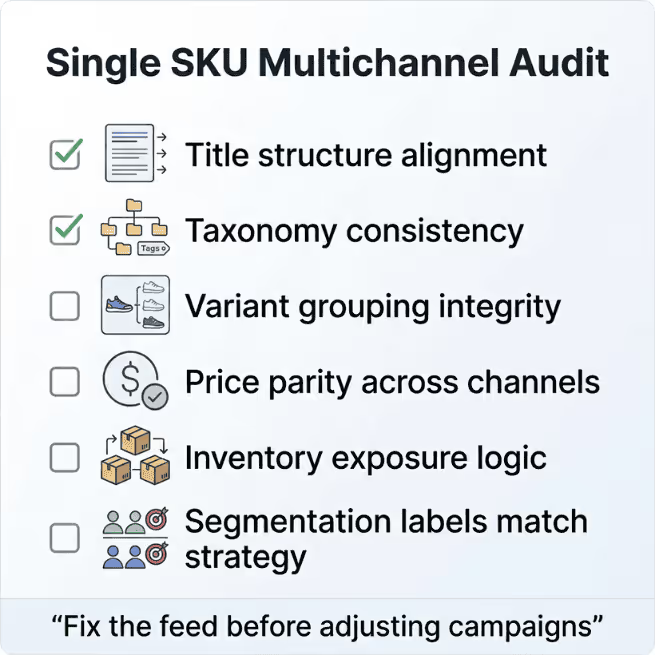
If those don’t match intent by channel, campaigns can’t scale predictably.
Fix the feed first.
Everything downstream gets easier after that.
In this post
Carlos Rodriguez is a seasoned content marketer with a background in marketing and advertising. Formerly at the helm of his own marketing agency, he now dedicates his expertise to guiding ecommerce merchants and marketers in mastering multichannel strategies. Outside of work, Carlos is an avid reader and hiker, often found traversing the mountain ranges of Cundinamarca like El Quinini.
Run a free feed audit and see which of your titles are matching queries you'd never choose to bid on.