




















































Walmart products are now appearing inside ChatGPT’s shopping responses following Walmart’s catalog-level integration with OpenAI’s retrieval infrastructure.
That’s not a surface feature update. It signals that structured catalog attributes now influence which products qualify for inclusion inside assistant-generated answers.
Most ecommerce feeds still optimize for schema compliance inside Google Merchant Center. That supports listing eligibility. It does not guarantee inclusion inside automated recommendation environments.
Here’s what actually changed.
When someone asks ChatGPT what backpack to buy for travel, the assistant can now retrieve Walmart SKUs directly from structured catalog sources and insert them into the response.
Not search links.
Actual purchasable listings.
That changes where eligibility filtering happens.
Instead of shoppers narrowing results inside category pages, AI systems retrieve candidate products from structured catalog endpoints and determine which SKUs satisfy matching thresholds for inclusion inside the answer.
Search engines ranked pages.
Assistants retrieve candidates and resolve eligibility before generating responses.
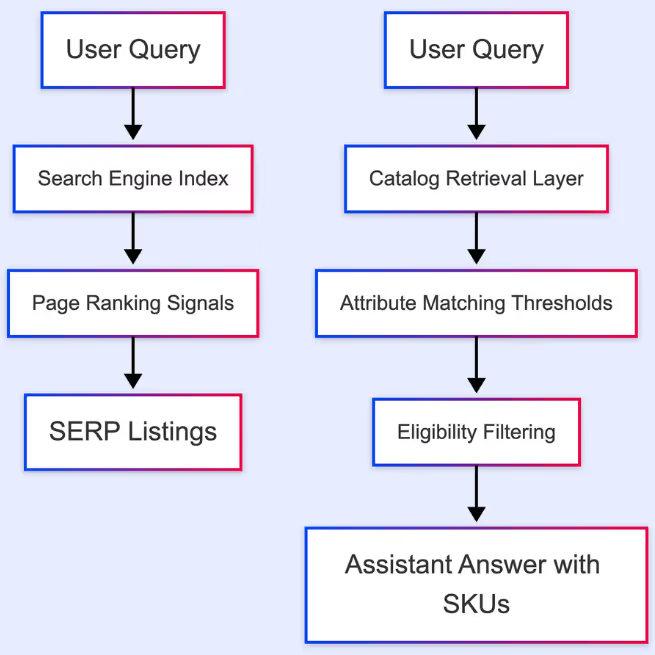
That’s the shift Walmart just made visible.
Amazon Rufus resolves product questions using catalog attributes alongside review embeddings and internal product graph relationships.
Google’s generative search layers summarize product sets before linking listings.
Perplexity injects purchasable SKUs into answers using structured merchant data and retrieval-layer ranking signals.
Shopify continues expanding merchandising automation layers that depend on structured merchant catalog ingestion rather than static inventory exports.
Performance Max already clusters inventory dynamically based on intent signals before determining SKU-level eligibility for impression delivery. [Performance Max automation signals]
The difference now is that these systems don’t just rank listings.
They increasingly determine whether a product qualifies for inclusion inside the answer at all.

%20Merchant%20Center%20Diagnostics%20vs%20Retrieval%20Strength.avif)
Most teams check feed health inside:
Google Merchant Center → Diagnostics → Needs attention
That confirms schema compliance.
It does not confirm retrieval matching strength.
A product can pass diagnostics while missing attributes like material or normalized color. Merchant Center still accepts it.
But missing attributes reduce how confidently systems resolve matching relationships across queries, comparisons, and automated discovery environments.
So the product remains indexable.
It just fails to meet thresholds for frequent retrieval.
If you’ve ever watched Performance Max listing group coverage drop while diagnostics stayed clean, you’ve already seen this behavior.
Approval used to signal readiness.
Now it mostly signals eligibility for indexing, not inclusion.

Many catalogs export variant ranges like:
S–XL
instead of structured availability like:
S in stock
M out of stock
L in stock
[Shopify variations and custom options]
That limits how precisely systems resolve availability state during retrieval and eligibility scoring.
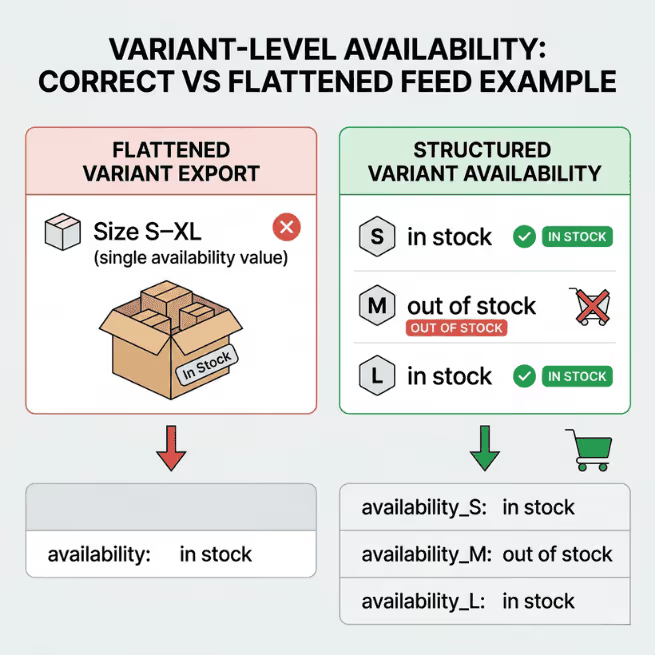
Platforms like Performance Max and Meta Advantage+ catalog ads depend on variant-level availability signals to determine when listings qualify for delivery. [catalog and product feed requirements]
When availability looks ambiguous, coverage shrinks.
You’ll usually see this first inside listing group visibility before it appears inside diagnostics.
Teams often misdiagnose this as a bidding issue. [group by rules]
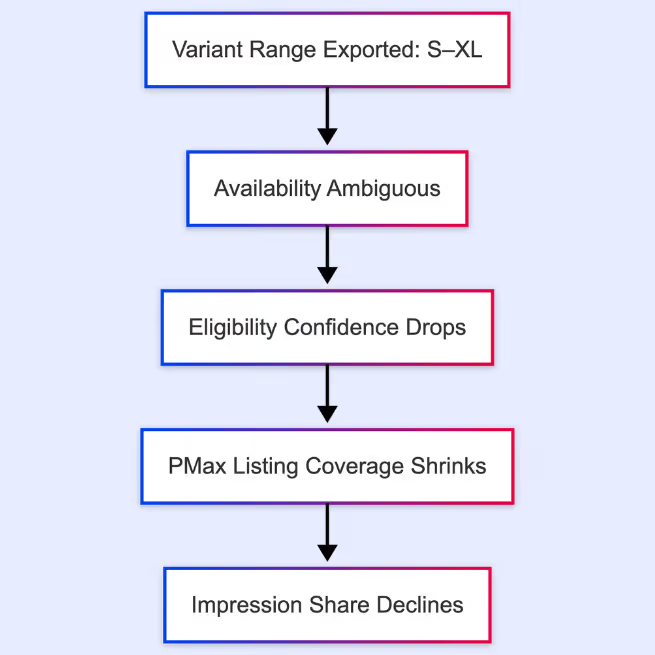
It’s usually a variant-level availability signal failure.
Google Merchant Center accepts broad category mappings.
Retrieval systems depend on classification precision.
Example:
Running Shoes exported as Athletic Footwear still passes validation.
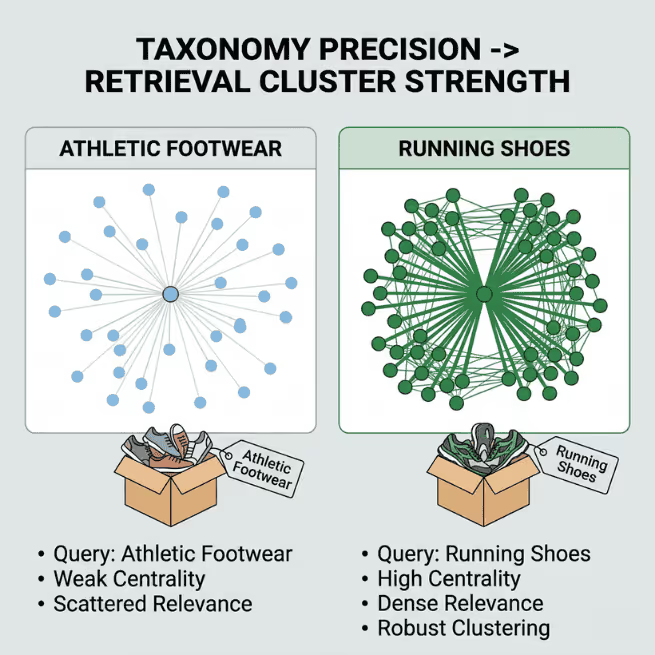
But the product may enter weaker retrieval clusters and match fewer relevant comparison contexts.
You’ll notice this when similar products stop appearing together inside Performance Max asset group insights or category-level reporting inside Merchant Center.
Keyword search tolerated loose taxonomy.
Retrieval systems depend directly on structured classification consistency.
This is where feed structure becomes campaign structure.
Most feed exporters inherit defaults.
That worked when channels handled interpretation downstream.
Now structured signals upstream determine eligibility across automated commerce environments.
Example rule teams often implement:
If gender missing and title contains “women,” assign gender = female.
Another:
If material exists in a Shopify metafield, append it before export.
These fixes improve how reliably products resolve inside vector similarity matching and comparison-layer retrieval across surfaces like Performance Max, generative search summaries, and marketplace recommendation systems.
Recommendation environments reward interpretability.
Templates produce averages.
Rules produce eligibility.
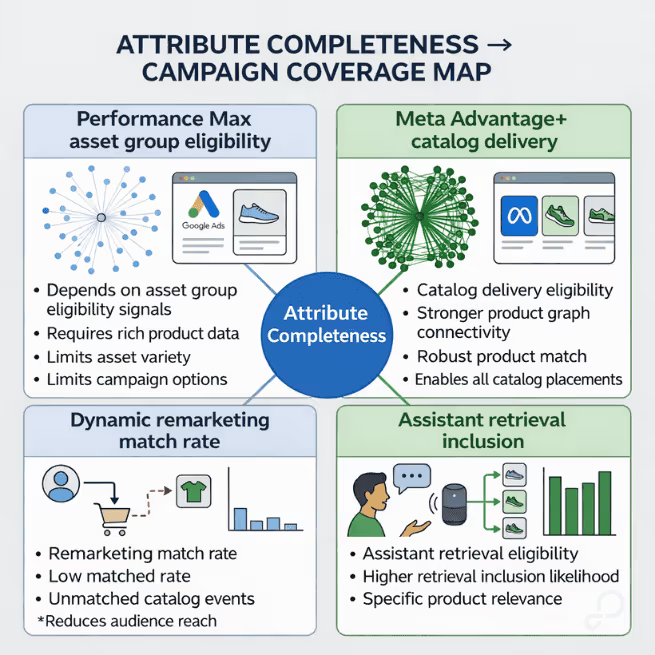
This isn’t theoretical.
Performance Max asset groups depend on attribute relationships inside your feed.
Meta Advantage+ catalog ads depend on variant availability signals. [Meta catalog requirements]
Dynamic remarketing depends on clean ID matching across sessions.
When attributes drift or variants flatten, listing groups lose retrieval coverage even while diagnostics remain schema-valid.
ROAS usually follows. [How product feed structure impacts ROAS and campaign reach]
Most teams don’t see the cause until they analyze attribute completeness across product clusters.
AI assistants didn’t create this constraint.
They made it easier to observe.
Walmart SKUs now appear inside conversational retrieval responses before many retailers have started treating feeds as retrieval infrastructure.
Automated recommendation systems can only surface products they can interpret reliably.
Retailers already maintaining marketplace-grade catalog structure adapt faster to assistant-mediated commerce environments because their attributes, variants, and taxonomy already support comparison logic. [preparing for AI-driven ecommerce]
Everyone else has to retrofit feeds after discovery behavior changes.
That’s harder to do mid-transition.
Start with attributes retrieval systems rely on most:
variant-level availability
normalized color values
material coverage
compatibility attributes
Google product category precision
title structure consistency
Run this inside:
Google Merchant Center → Diagnostics → Missing optional attributes [Missing optional attributes]
Most teams never check this report.
It often highlights products with weaker semantic matching signals across retrieval environments.
Then compare those gaps against Shopify metafields or enrichment rules inside your feed platform.
Conditional attribute rules let you fix this once instead of patching it separately across channels [Feed rule operators]. That’s what feed rules are designed to do—map, enrich, and standardize attributes before export.
Run this audit monthly after major assortment updates or seasonal catalog changes.
That’s when attribute drift appears first.
Search engines ranked product pages.
Automated shopping systems increasingly rely on structured catalog attributes as retrieval primitives.
Assistants don’t crawl your storefront.
They resolve structured catalog signals that originate in feeds and product data infrastructure.
And the teams that control feed structure increasingly control whether their SKUs qualify for inclusion inside assistant-mediated shopping responses.
Open:
Google Merchant Center → Diagnostics → Missing optional attributes
Filter for:
material
variant detail
normalized color
Those fields already improve semantic matching strength across automated discovery environments.
Carlos Rodriguez is a seasoned content marketer with a background in marketing and advertising. Formerly at the helm of his own marketing agency, he now dedicates his expertise to guiding ecommerce merchants and marketers in mastering multichannel strategies. Outside of work, Carlos is an avid reader and hiker, often found traversing the mountain ranges of Cundinamarca like El Quinini.
Run a free feed audit and see which of your titles are matching queries you'd never choose to bid on.